

What counts as careless driving in Ontario?
Driving without due care and attention, or without reasonable consideration for other people using the road. That is the test in section 130 of the Highway Traffic Act, and it applies in parking lots as well as on public roads.
Speeding and handheld phone rules list specific acts. Careless driving describes a way of driving, so the same charge can follow very different situations.
Ontario gives its own example. Eating, drinking, grooming, smoking, reading and reaching for objects are not covered by Ontario’s distracted driving rules, but any of them can lead to a careless driving charge.
A crash is not part of the definition, so you can be charged without one. When there is a collision, the careless conviction is what reaches your record, not the crash. The guide on whether a drivers abstract shows accidents explains the difference.
Is careless driving a criminal offence in Ontario?
No. Careless driving is a provincial offence under the Highway Traffic Act. Its criminal counterpart is dangerous driving, under the Criminal Code of Canada, and the licence consequences of that are far heavier.
Careless driving
- A provincial offence, not a criminal conviction
- For a full licence, a court suspension is possible but not automatic
Dangerous driving
- A criminal conviction
- Ontario licence suspended for 1 year on a first conviction
- 3 years on a second and indefinitely on a third, counted over 10 years
Both are listed on the same 3-year driver record. Stunt driving is a separate Highway Traffic Act charge with its own roadside penalties, covered in stunt driving and your record. Impaired driving convictions follow the same Criminal Code suspension ladder as dangerous driving, and the impaired driving guide walks through it.
What is the penalty for careless driving in Ontario?
A fine or jail, or both, plus 6 demerit points, and the court can also suspend your licence. Section 130 sets the ranges below.
| Rule | Careless driving | Careless driving causing bodily harm or death |
|---|---|---|
| Demerit points | 6 | 6 |
| Fine | $400 to $2,000 | $2,000 to $50,000 |
| Jail | Up to 6 months, instead of or as well as the fine | Up to 2 years, instead of or as well as the fine |
| Court licence suspension | Up to 2 years | Up to 5 years |
| Driver improvement course | Not listed | Mandatory on conviction |
| Victim was a pedestrian, cyclist or road worker | Not applicable | The court must treat it as an aggravating factor |
| Deadline to lay the charge | 2 years from the incident | 2 years from the incident |
What the 6 points mean for you depends on the points you already have. Your Ontario drivers abstract shows your current total.
How many demerit points is careless driving in Ontario?
Six. Only two offences in Ontario’s demerit point table carry more: failing to remain at the scene of a collision and failing to stop for police, at 7 each.
The points are added on conviction, not when you are charged, and they count toward your total for two years from the offence date.
- 0 to 5 pointsBelow the first warning level
- 6 to 8 pointsWarning letter
- 9 to 14 pointsA second warning, and you may be called to an interview
- 15 or moreLicence suspended, for 30 days the first time
Starting from a clean record, one more 3-point speeding conviction (16 to 29 km/h over) within two years puts you at 9, where an interview can be required. If you already have 9 or more, the 6 points take you to 15 or more, which triggers a demerit suspension (30 days the first time).
If you are convicted of more than one offence from the same incident and the court imposes no suspension, points are recorded only for the conviction carrying the most. A careless conviction plus a lesser ticket from the same crash adds 6, not both totals.
G1, G2, M1 and M2 drivers
For a novice driver it is far more serious. Because careless driving carries 4 or more points, the points are recorded as zero and a novice suspension applies instead: 30 days for a first such conviction, 90 days for a second, and cancellation of the novice licence for a third, which means starting graduated licensing over. The drivers abstract guide for G1 and G2 drivers covers what a new driver’s record shows.
The full demerit points chart lists every offence and its points, and how Ontario demerit points work sets out each threshold.
What happens if careless driving causes bodily harm or death?
It becomes a separate charge under section 130(3) of the Highway Traffic Act: a fine of $2,000 to $50,000, up to 2 years in jail, or both, and the court can suspend your licence for up to 5 years. It is still a provincial offence, not a criminal one.
A conviction also carries 6 demerit points and a mandatory driver improvement course. When the person hurt or killed was a pedestrian, a cyclist or someone working on the road, the court must treat that as an aggravating factor when it sets the sentence.
How does careless driving show on your driving record, and for how long?
Once you are convicted, your 3-year driver record lists the careless driving conviction with its conviction date. The 6 points count toward your total for two years from the offence date, and the conviction stays listed while it falls within the past three years.
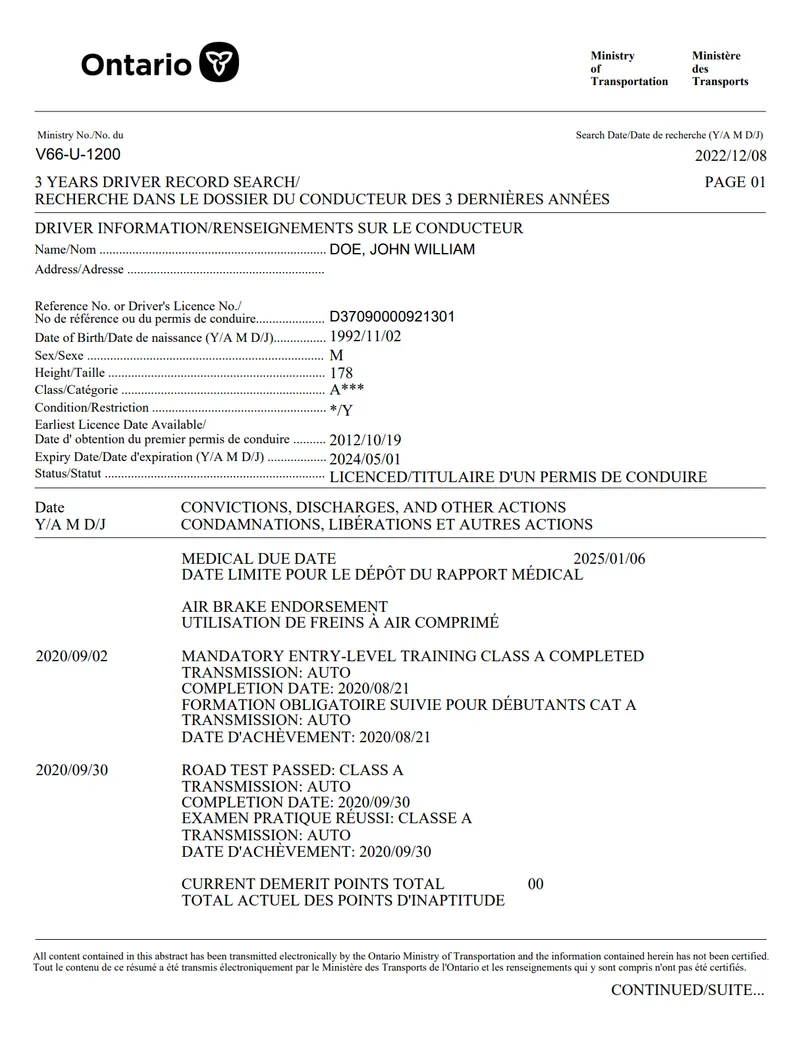
Points and convictions run on separate clocks, which is why a record can show a careless conviction with none of its points still counting. Here is the usual sequence.
The incident and the charge
Nothing goes on your record yet. A charge on its own carries no points and no conviction.
The conviction
The conviction is listed and the 6 points are recorded as of the offence date. If you appeal and the Ministry is served with notice of the appeal, the conviction and points stay off your record unless the conviction is upheld.
Any court suspension
If the sentence included a licence suspension, no points are recorded for the conviction. The record lists the suspension instead, your licence is suspended while it runs, and the reinstatement is listed once you are reinstated.
Two years after the offence date
The 6 demerit points expire and drop out of your total.
Outside the three-year window
The conviction no longer appears on the 3-year driver record. Longer records, such as the complete driver record, still go back as far as records are available.
What your 3-year record shows after a careless conviction
- The careless driving conviction and its conviction date
- Your demerit point total, including the 6 points while they count
- Any court suspension, and your reinstatement once it is granted
- Your licence status, for example licensed or suspended
- An active fine suspension, if an unpaid fine leads to one
What it does not show
- A charge that has not ended in a conviction
- The collision itself. The 3-year record lists convictions, not collisions.
- Convictions from more than three years ago
The unpaid fine is the entry people forget. A careless driving fine left unpaid can lead to a licence suspension, and it must be paid in full before you can renew your licence. See licence suspensions for unpaid fines for the fix and how long convictions stay on your record for the timing. To know which of these is on yours today, get your driving record online and read it.
Will insurers and employers see a careless driving conviction?
Yes. The standard Ontario auto insurance application asks for every conviction from the last 3 years, the same window your 3-year record covers, and that record is the one commonly used for employment.
Insurance
Ontario says drivers convicted of aggressive, careless or stunt driving will see a substantial increase in their insurance rates, or could become uninsurable. How big the increase is varies from one insurer to another.
FSRA, Ontario’s insurance regulator, treats drivers with many convictions or at-fault accidents as high-risk: they pay higher rates and can end up with the Facility Association, the insurer of last resort. The application also asks whether any licence in the household was suspended or cancelled in the last 6 years, so a court suspension is asked about separately and over a longer period.
Insurers also share history through AutoPlus, which can carry conviction codes and reach back further than three years. See drivers abstracts for insurance for what an insurer reads on your record.
Employment
Anyone with your licence number can order your 3-year driver record, so an employer hiring for a driving job can see a careless conviction for as long as it is inside the window. The drivers abstract for employment guide explains what employers look for.
Commercial drivers also have a CVOR Driver Abstract, a five-year record that includes convictions while driving a commercial vehicle in Ontario, so a careless conviction in a truck or bus can show there too.
What should you do after a careless driving charge?
Respond before the deadline, get advice on the charge, and find out exactly what is on your record now.
Note the deadline
Your ticket or summons says how to respond and by when. Ignore a ticket and a conviction can be entered without a hearing.
Get advice before you pay
Under the Provincial Offences Act, paying the fine out of court is a guilty plea and a conviction. A lawyer or paralegal can explain your options, including whether to dispute the charge.
Check your record now
Your current point total and recent convictions decide what 6 more points will mean: a warning letter, an interview or a suspension. Your 3-year driver record shows both.
Order a fresh copy after the outcome
Once the case is over, confirm what was recorded, including the conviction date, the points and any suspension or reinstatement, before an insurer or a new employer reads it.
Step three is the one you can do today. Order your driving abstract online for $39.99 and the PDF arrives in your inbox instantly after payment. Occasional delays can occur.
Frequently asked questions
Can I be charged with careless driving in a parking lot?
Yes. The careless driving section of the Highway Traffic Act covers parking lots and similar places as well as public roads, so the same charge, points and penalties apply.
Can police lay a careless driving charge weeks after a collision?
Yes. A careless driving charge can be laid up to two years after the incident, so a charge that arrives after an investigation is not unusual.
Does paying a careless driving ticket count as pleading guilty?
Yes. Paying the fine out of court counts as a guilty plea and a conviction, so the conviction and the 6 points go on your record. A lawyer or paralegal can explain your options before you pay.
Does careless driving in my own car show on a CVOR abstract?
No. The CVOR Driver Abstract only covers your time operating commercial vehicles in Ontario. A careless conviction in your own car is listed on your 3-year driver record instead.
Will one careless driving conviction suspend a full G licence?
Not on points alone if you have fewer than 9 points still counting. Six points on their own put a fully licensed driver in the warning letter range, but with 9 or more points from the past two years, a careless conviction takes you to 15 or more, which triggers a demerit suspension (30 days the first time). The court can also suspend your licence for up to two years as part of the sentence.
I have a G2. What does a careless driving conviction mean for me?
At least a 30-day suspension, and the licence can be cancelled. For novice drivers the points are recorded as zero and escalating suspensions apply instead: 30 days, then 90 days, then cancellation of the novice licence.
Does a careless driving conviction in another province count in Ontario?
Yes. A careless driving conviction in another Canadian province or territory, New York or Michigan adds demerit points to your Ontario licence as if the offence had happened in Ontario.
How do I see my current demerit point total?
Order your 3-year Ontario driver record. It shows your point total and your convictions from the past three years, costs $39.99, and arrives by email instantly after payment. Occasional delays can occur.
Sources: Highway Traffic Act, section 130 (careless driving, including causing bodily harm or death), section 172 (stunt driving and racing) and section 41 (licence suspensions for Criminal Code convictions); Ontario Regulation 339/94 (Demerit Point System); Provincial Offences Act, section 8 (paying a ticket); Criminal Code of Canada (dangerous driving); Ontario’s guidance on speeding, aggressive and distracted driving; the Ministry of Transportation’s description of the 3-year driver record; FSRA guidance on high-risk drivers; and the Ontario Application for Automobile Insurance (OAF 1). This guide is general information, not legal advice.