

Does an Ontario driving record reset after 3 years?
Not as a whole. Demerit points expire two years after the offence date and convictions leave once they are older than the record’s three-year window, each on its own date. A record only looks fresh when every entry in it has aged out.
The 3-year driver record is a window that slides forward a day at a time. Entries drop out of it one by one, so a conviction from early in the window and one from last month leave years apart.
What actually changes it:
- Points reaching two years from their offence date
- A conviction moving outside the three-year window
- A suspension and its reinstatement moving outside that window
- A conviction overturned through the court
Does your driving record reset at 25, on renewal or when you move?
No. Your age, a renewal and a move do not change the convictions, suspensions or points your record shows.
No Ontario record rule clears anything at 25. Your record keeps each entry until it ages out, whatever your birthday.
| The myth | What actually happens |
|---|---|
| It resets when you turn 25 | Nothing comes off on a birthday. Each entry ages off on its own dates. |
| Renewing your licence wipes it | Renewal replaces the card. Convictions stay listed, and defaulted driver fines must be paid in full before you can renew. |
| It all clears on January 1 | There is no calendar reset. Points expire two years from each offence date, on any day of the year. |
| Getting your full G starts you over | Only the class changes. Convictions stay listed, active points keep counting, and the full-licence thresholds apply from then on. |
| Moving away is a clean slate | Moving does not change what your record already shows. A new province or a new insurer can ask about your Ontario history, so it pays to see what is on it before you go. |
| Paying or ignoring the ticket ends it | Paying the fine is a guilty plea and a conviction (Provincial Offences Act, s. 8). Ignoring the ticket lets the court enter a conviction without a hearing (s. 9). |
| Zero points means a clean record | Points expire after two years. The conviction stays on the 3-year record for three, so zero points can sit next to a listed conviction. |
| Off the 3-year record means gone | The 3-year record is only a window. MTO keeps Criminal Code convictions on your driver record for at least 10 years. |
Leaving the province? See moving out of Ontario with your driving record. Ticketed on a trip? See out-of-province tickets and your Ontario record.
When do demerit points and convictions come off an Ontario record?
Demerit points stop counting two years after the offence date. Convictions stay on the 3-year driver record for three years, so a conviction always outlasts its points.
- 2 yearsDemerit points count toward your totalMeasured from the offence date
- 3 yearsConvictions, suspensions and reinstatements on the 3-year recordEach conviction listed with its date
Points are recorded on conviction but dated back to the offence, so a ticket that takes months to resolve arrives with part of its two years already used. The conviction is a separate entry that keeps showing after its points are gone. Even offences with no points, such as speeding 15 km/h or less over the limit, are convictions.
Point values and thresholds are in how Ontario demerit points work, and the lifespan of each kind of entry is in how long convictions stay on your record.
How does one speeding ticket age off your record?
In two steps. Its points stop counting two years after the offence date, and the conviction stays listed until it is older than the three-year window.
Here is a single 3-point speeding ticket, 20 km/h over the limit, followed from the roadside to the day it stops showing. The driver chose to fight it.
Month 0: the offence
Nothing is on the record yet, but the two-year points clock starts today.
Month 7: the conviction
Convicted at trial, the driver gets the conviction and 3 points, with 17 of their 24 months left. Paying or ignoring the ticket would have meant a conviction too, only sooner.
Month 24: the points expire
The 3 points stop counting and the total drops. The conviction stays listed with its conviction date.
Later: the conviction ages out
Once it is older than the record's three-year window, it no longer prints on the 3-year record.
After that: still in MTO's longer-term records
Ontario's extended and complete driver records list convictions as far back as available, so the history is not erased, only out of the 3-year window.
Between steps 3 and 4, for a year or more, the record lists a speeding conviction while the demerit point total reads zero. Check only your total and you would call yourself clean. An insurer reading the record would not. See what counts as a clean driving record.
Can an old ticket still count against you after its points expire?
Yes. Several Ontario rules look back five or ten years when setting a penalty, well past the two-year life of demerit points and the three-year span of the driver record.
| Rule | How far back it looks | What an earlier entry changes |
|---|---|---|
| Handheld device or display screen | Offence committed less than five years after a previous conviction | 6 demerit points instead of 3 |
| Demerit point suspension | Offence committed within two years after a previous demerit suspension ended | 6 months instead of 30 days (full licence) or 60 days (novice) |
| Speeding 50 km/h or more over | Earlier convictions within five years | Court suspension of up to 30 days, then up to 60 days, then up to one year |
| Warn range (blood alcohol 0.05 to 0.079) | Earlier warn range suspensions within 10 years | 7-day suspension, then 14 days, then 30 days plus a six-month ignition interlock condition |
| Criminal Code driving conviction (impaired, refusal, dangerous driving and others) | Earlier convictions within 10 years | Licence suspended for 1 year, then 3 years, then indefinitely |
These rules run on the history MTO holds, not on what your 3-year record happens to print. The criminal side is covered in impaired driving and your Ontario driving record.
Why would an insurer ask about something that is off your record?
Because the insurance application asks its own questions. The standard Ontario form wants convictions from the last 3 years, but suspensions and claims from the last 6.
| Item | Your 3-year driver record | Standard Ontario application (OAF 1) |
|---|---|---|
| Driving convictions | Past 3 years | Last 3 years, for you and every listed driver |
| Licence suspensions | Past 3 years, plus any active fine suspension | Any suspension or cancellation in the household in the last 6 years |
| Accidents and claims | Not among its listed contents | Last 6 years |
| Policies cancelled by an insurer | Not shown | Last 3 years |
On convictions the two match: three years asked, three years shown. Your own 3-year driver record is the easy way to answer that question with the right dates instead of from memory.
Insurers also check AutoPlus, an industry claims and policy database that is separate from the MTO record. The insurer asking chooses how many years to pull, which can reach well past three. See how far back insurers check your driving record and drivers abstracts for insurance.
Can you get your driving record cleared in Ontario?
Not on request. Entries leave the 3-year record by ageing out, and the recognised early routes run through the court, such as an appeal or a reopening.
- An appeal. If a conviction that carries demerit points is appealed and the Registrar of Motor Vehicles is served with notice of the appeal, the conviction and its points are not entered, or are taken off, unless the conviction is upheld.
- A reopening. If you were convicted without a hearing, for example over a ticket you never received, you can apply to have the conviction struck out within 15 days of finding out about it.
Both are court processes, and a lawyer or paralegal can tell you whether either fits. An entry that is simply not yours needs a different fix: see how to correct an error on your driving record.
How do you see what is still on your driving record?
Order your 3-year driver record. It shows your demerit point total and the convictions, suspensions and reinstatements from the past three years, so you can see exactly what has aged off and what has not.
Five things to read on it:
- The demerit point total: the points still counting
- Each conviction, with its conviction date
- Suspensions and reinstatements from the past three years
- Any active fine suspension
- Your licence status: licensed, unlicensed or suspended
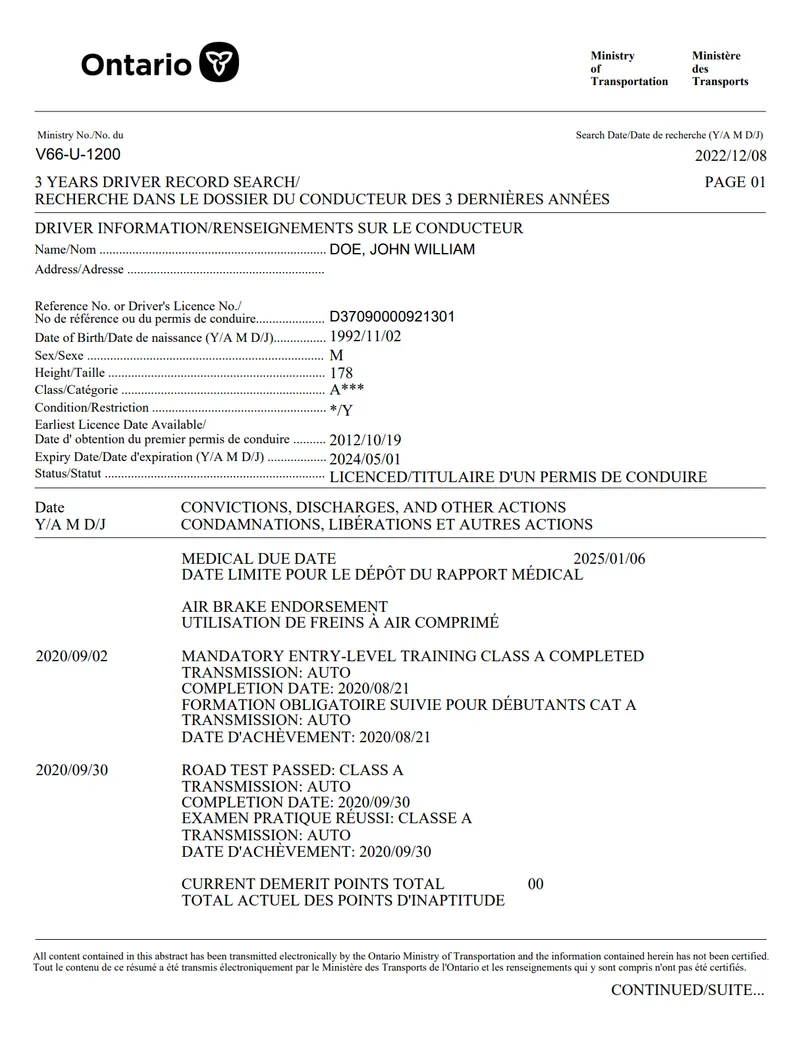
Put the offence date from your ticket next to the conviction date on the record and both clocks are easy to mark: two years from the offence for the points, and the three-year window for the conviction.
The online licence status check cannot do this. It only says whether a licence is valid (see checking if your Ontario licence is valid).
To see your own, order your Ontario drivers abstract online: one short form, $39.99, and the PDF arrives in your inbox instantly after payment. Occasional delays can occur. For reading the point total line by line, see how to check your demerit points.
Frequently asked questions
Do demerit points come off on January 1?
No. Each set of points stops counting two years after its own offence date, so a point total can drop on any day of the year.
Does my driving record clear when I get my full G licence?
No. Your licence class changes, but convictions from the past three years stay listed and active points keep counting until their two-year mark.
What does a clean drivers abstract look like?
No convictions, suspensions or active fine suspensions in the past three years, a demerit point total of zero, and a licence status of licensed. Zero points alone is not enough if a conviction is still listed.
If my last ticket was over three years ago, will my abstract be clean?
Usually, if the ticket was also dealt with more than three years ago and nothing has happened since. The record lists convictions from the past three years, so a ticket that took months to resolve can still show for a while. An insurance application can also ask about suspensions and claims from the last 6 years.
Will a ticket from another province stay off my Ontario record?
Not necessarily. For an Ontario driver, convictions in other Canadian provinces and territories, New York and Michigan for offences such as speeding or careless driving add demerit points to the Ontario record as if the offence happened in Ontario.
Can I pay to have a conviction taken off my driving record?
Not by paying for it. Accurate entries age off on their own dates, and challenging a conviction is a court matter, such as an appeal or a reopening. A lawyer or paralegal can advise whether either fits your case.
Does a speeding ticket with no demerit points still show on my abstract?
Yes. Speeding 15 km/h or less over the limit carries no points, but it is still a Highway Traffic Act conviction, and the 3-year record lists those convictions from the past three years whether or not they carried points.
Sources: Demerit point timing and thresholds, the reductions to 7 and 4 points, the effect of an appeal, the repeat handheld device rule and out-of-province points: Ontario Regulation 339/94 (Demerit Point System) under the Highway Traffic Act. Paying or ignoring a ticket and reopening a conviction: Provincial Offences Act, ss. 8, 9 and 11. Speeding, warn range and Criminal Code suspension lookbacks: Highway Traffic Act, ss. 41, 48 and 128. Record contents and retention: the Ministry of Transportation’s description of the 3-year driver record and the MTO Driver’s Handbook. Insurance questions: the Ontario Application for Automobile Insurance (OAF 1).