

What does a clean drivers abstract mean?
It means the record has nothing against you: no convictions, no suspensions and no active fine suspensions from the past three years, and a demerit point total of zero.
A drivers abstract is the everyday name for the uncertified 3-year Ontario driver record kept by the Ministry of Transportation (MTO). “Clean” is not a word printed on it. It is shorthand that insurers, employers and rideshare platforms use for a record with nothing negative in the window they look at.
Because the 3-year record only covers the past three years, a clean abstract means a clean last three years. It says nothing about what happened before that, and it does not have to.
A clean abstract shows
- Licence status: licensed
- No Highway Traffic Act convictions in the past 3 years
- No Criminal Code of Canada convictions in the past 3 years
- No suspensions or reinstatements in the past 3 years
- No active fine suspensions
- A demerit point total of zero
Any one of these means it is not clean
- A speeding, stop sign or other traffic conviction, even with 0 points
- A careless driving, stunt driving or distracted driving conviction
- A suspension that has since been reinstated
- A licence suspended for an unpaid traffic fine
- A status of suspended or unlicensed
- Any demerit points still counting
The quickest way to know which column you are in is to read your own Ontario drivers abstract. Surprises usually come from the not-clean list: an old small ticket, or a suspension that has already ended.
What does a clean drivers abstract look like?
A clean abstract is short. The driver details are filled in, no convictions or suspensions are listed, the status reads licensed, and the demerit point total at the bottom reads zero.
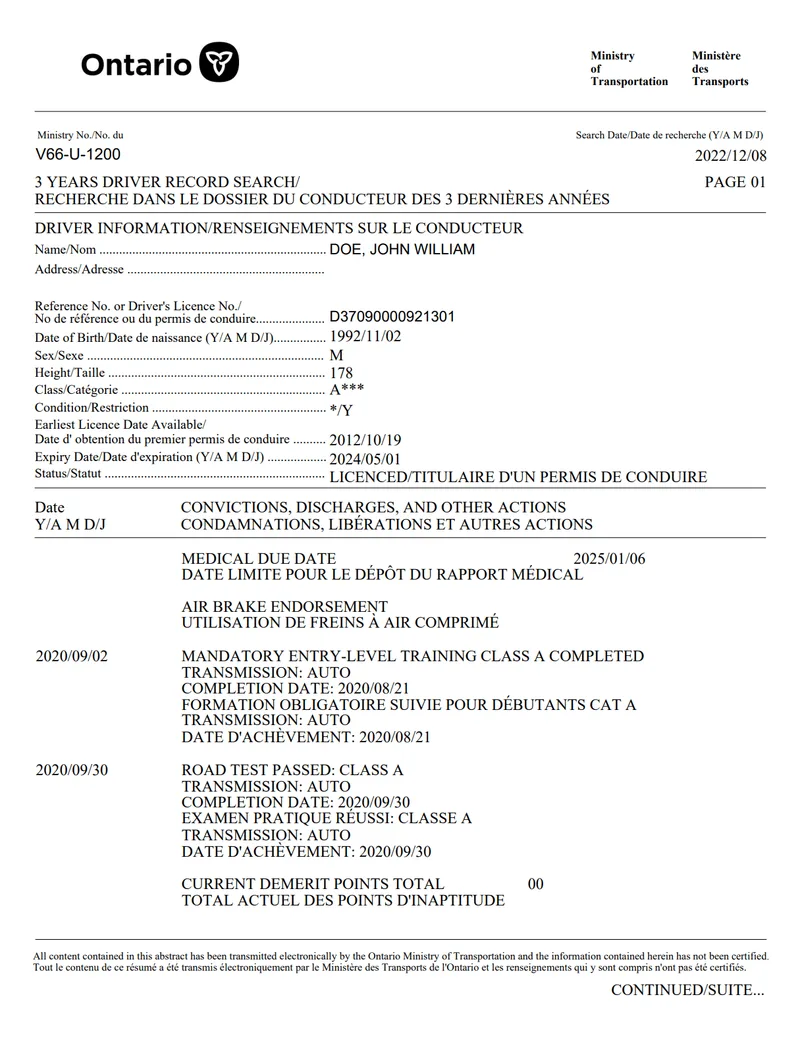
Not every entry is an offence. The main section is headed “Convictions, discharges and other actions”, and on the sample above it holds a medical due date, an air brake endorsement, a completed training course and a road test passed. None of those are offences. What matters is whether anything listed is a conviction or a suspension.
| Part of the record | On a clean abstract | What would make it not clean |
|---|---|---|
| Licence status | Licensed | Suspended or unlicensed |
| Convictions (past 3 years) | Nothing listed against you | Any Highway Traffic Act or Criminal Code conviction, with or without points |
| Suspensions and reinstatements (past 3 years) | None | Any suspension or reinstatement listed in the past 3 years, even one that has ended (expired medical suspensions are not shown) |
| Active fine suspensions | None | A licence suspended because a traffic fine went unpaid |
| Demerit point total | Zero | Any points from offences in the last two years |
| Licence class, conditions, endorsements | Whatever applies to you | Usually neutral (glasses, air brakes). A condition tied to an offence, such as ignition interlock, is a different matter. |
Conditions such as needing glasses to drive, or an air brake endorsement, are part of your licence details. They are not offences, and they do not stop a record from being clean.
For a field-by-field walk through the document, see what an Ontario driver abstract looks like and how to read your driver abstract.
Does zero demerit points mean a clean abstract?
No. Zero points is one of the conditions for a clean abstract, not proof of one. A conviction can sit on your record with zero points next to it.
Points and convictions run on different clocks. Demerit points count for two years from the date of the offence. The 3-year record lists convictions from the past three years. So a conviction can still be listed after its points have expired, and the total reads zero while the record is not clean.
Zero points and clean
- No convictions listed in the past 3 years
- No suspensions or reinstatements listed
- No active fine suspension
- Status: licensed
Zero points but not clean
- A speeding ticket 1 to 15 km/h over: a conviction that never carried points
- A ticket whose points expired after two years, still listed as a conviction
- A novice driver convicted of a 4-point offence: points recorded as zero, suspension instead
- A suspension that has ended, still listed with its reinstatement
The novice case catches people out. When a G1, G2, M1 or M2 driver is convicted of an offence worth four or more points, the points are recorded as zero and a suspension applies instead: at least 30 days on a first offence. The record shows a zero point total and still is not clean.
Out-of-province tickets matter too. Convictions in other Canadian provinces and territories, New York and Michigan for offences such as speeding or careless driving add demerit points to an Ontario record as if the offence happened here. More in out-of-province tickets and your Ontario record, and the full points system in Ontario demerit points.
What does not stop an abstract from being clean?
Parking tickets, camera tickets, a charge that never became a conviction, and a collision on its own. Parking convictions are not reported to the driving record, and camera tickets carry no points and do not go on anyone’s driving record, so none of these is a driving conviction against you.
| Item | Counts against a clean abstract? | Why |
|---|---|---|
| Parking ticket | No | Courts do not report parking by-law convictions to the driving record. Unpaid parking fines are a licence plate matter. |
| Red light camera ticket | No | It goes to the vehicle owner, carries no demerit points and does not affect anyone’s driving record. |
| Speed camera (photo radar) ticket | No | Never carried points and never went on the driving record. Ontario stopped issuing them in November 2025. |
| A ticket you are still fighting | No | A ticket is a charge. Points and the conviction are added only if you are convicted. |
| A collision with no conviction | No | Collisions are not listed among the 3-year record contents. A conviction arising from one is. |
| An expired medical suspension | No | The 3-year record does not include expired medical suspensions. |
| A speeding ticket 1 to 15 km/h over | Yes | No points, but it is still a conviction, so it is listed. |
That last row is the one people get wrong. A small speeding ticket costs no points, so it feels like it does not count. On the abstract it is a conviction like any other.
Camera, parking and 407 tickets are covered in do camera, parking and 407 tickets show on your record, and collisions in does a driver abstract show accidents.
How long until your drivers abstract is clean again?
Each entry leaves on its own date. Points stop counting two years after the offence date, and a conviction or suspension stops showing once it is no longer within the past three years.
There is no single reset day. Your record does not clear at age 25, when you renew, when you move up from a G2 to a G, or on January 1. The full myth list is in does your driving record reset.
You get a ticket
It is a charge. Nothing is added to your record yet.
The ticket ends in a conviction
By paying it, by a finding of guilt, or by letting the deadline pass. The conviction is listed, and any points are recorded as of the offence date.
Two years after the offence date
The points stop counting and your total drops. The conviction is usually still listed, so the abstract is not clean yet.
The conviction leaves the three-year window
Once it is no longer within the past three years, it stops showing on the 3-year record. If nothing else is listed, your abstract is clean.
Paying a ticket counts as a conviction once the payment is accepted (Provincial Offences Act). Points, on the other hand, are dated from the offence. The record lists each conviction with its own date.
| Entry | Points and penalties | Stops showing on the 3-year record |
|---|---|---|
| Minor conviction with points (for example 3-point speeding) | Points count for 2 years from the offence date | Once it is no longer within the past 3 years |
| Conviction with no points (for example 1 to 15 km/h over) | No points to count | Once it is no longer within the past 3 years |
| Suspension and its reinstatement | Not a points item | Once they are no longer within the past 3 years |
| Active fine suspension | Not a points item | Listed as active until the fine and reinstatement fee are paid and the licence is reinstated. Check a fresh record afterwards to see what is still listed. |
| Criminal Code conviction (for example impaired driving) | Brings a licence suspension: 1 year on a first conviction, or longer | After 3 years on this record, but MTO keeps it on file for at least 10 years |
After a demerit point suspension, your total does not go back to zero. A fully licensed driver’s points are reduced to 7, and a novice driver’s to 4, so the record takes longer to come clean. The detail on each clock is in how long convictions stay on your record. If a fine suspension is the problem, see licence suspended for unpaid fines.
Counting down to a date? Check your 3-year driver record rather than guessing. It lists each conviction with its date, so you can see what is still within the past three years.
Is a clean abstract the same as a clean insurance record?
No. Your abstract shows driving convictions and suspensions. Your insurance history shows policies and claims. An insurer looks at both, and over different periods.
Your drivers abstract
- Convictions, suspensions and reinstatements from the past 3 years
- Your current demerit point total
- Licence status, class and conditions
- No claims and no collisions on their own
Your insurance history
- Policies and claims, shared through the AutoPlus database
- How far back it goes is set by the insurer asking
- At-fault accidents can count even with no conviction
- Not part of your driving record
| Question on the application | Period asked | On the 3-year abstract? |
|---|---|---|
| Driving convictions | Last 3 years | Yes, the same 3 years |
| Accidents or claims | Last 6 years | No |
| Licence suspended or cancelled | Last 6 years | Only the past 3 years |
| Policy cancelled by an insurer | Last 3 years | No |
On convictions the two line up exactly: the application asks for three years, and the abstract shows three years. That is why a clean abstract is the document insurers care about for the conviction question.
Some accidents cannot be held against you. Ontario insurers may not use past claims in rating where you were 25 per cent or less at fault (for accidents from September 1, 2010), and for private passenger vehicles they may not consider a single minor accident unless there was more than one at-fault minor accident in the previous three years.
For the insurance side in full, see drivers abstracts for insurance, driver abstract vs AutoPlus and how far back insurers check.
What do employers, insurers and rideshare platforms consider clean?
Each one sets its own standard, but the evidence they read is the same 3-year record. Many look for no convictions and no suspensions; what they will accept varies.
Insurers
Ontario’s insurance regulator lists your driving record among the things your premium is built on: previous accidents, how long you have been licensed, driver training, speeding tickets and other convictions. The better the record, the lower the premium, and the same driver can be quoted differently by different companies.
Employers
Employers that hire drivers commonly ask for a recent abstract, and many insurers and employers ask for a record issued within the last 30 days. MTO advises commercial vehicle operators to obtain a driver abstract when hiring a driver and at least every year after that. The guide to drivers abstracts for employment covers what hiring managers look at. Truck and bus drivers may also be asked for a CVOR driver abstract, which covers up to five years of commercial driving in Ontario.
Rideshare and delivery platforms
Platforms publish their own driving history rules and change them from time to time, so check the current requirement on the platform itself. What does not change is the evidence: a recent 3-year record. See drivers abstracts for Uber and Lyft.
New drivers
A G1 or G2 driver with nothing recorded has a clean record, not a weak one. Insurers also weigh how long you have been licensed, but a short history with nothing recorded is still a clean one. See driver abstracts for G1 and G2 drivers.
How do you prove you have a clean driving record?
Send your uncertified 3-year Ontario driver record. It is the document insurers and employers ask for, and it either shows a clean three years or it does not.
Order your 3-year record
Get your driving record online with one short form. The PDF arrives by email instantly after payment. Occasional delays can occur.
Check four things
Status reads licensed, no convictions are listed, no suspensions or reinstatements are listed, and the demerit point total is zero.
Check the date it was issued
Many insurers and employers ask for a record issued within the last 30 days, so order close to when you need it.
Send the PDF as it is
Forward or upload the file unchanged. Keep the original email in case you are asked again.
Your word is not proof, and neither is a licence status check. The MTO online status check only says whether a licence is valid right now; it does not show convictions, points or past suspensions. The difference is explained in how to check an Ontario licence status.
If the record lists something you believe is wrong, read what to do about an error on your driver abstract. For a conviction you want to challenge, a lawyer or paralegal can advise. Otherwise, order your drivers abstract Ontario copy for $39.99, paid once, with no account and no subscription.
Frequently asked questions
What does clean abstract mean on a job posting or insurance form?
It means they want a 3-year Ontario driver record that lists no convictions, no suspensions and no active fine suspensions, shows a demerit point total of zero, and gives your licence status as licensed. You may also see it written as a clean driving abstract or a clean driving record.
What is considered a clean driving record in Ontario?
Insurers and employers generally mean a record with no driving convictions and no suspensions. There is no official definition, so each organization applies its own standard, but the standard Ontario insurance application asks about convictions from the last 3 years, the same window the abstract covers.
Can I have zero demerit points and still not have a clean abstract?
Yes. Points count for two years from the offence date, while the record lists convictions from the past three years, so a conviction can still be listed after its points are gone. Speeding 1 to 15 km/h over the limit is a conviction with no points at all.
Do parking tickets or camera tickets affect a clean abstract?
No. Courts do not report parking convictions to your driving record, red light camera tickets go to the vehicle owner with no demerit points, and speed camera tickets (no longer issued since November 2025) never carried points or affected driving records. None of them is a driving conviction against you.
Does a car accident stop my drivers abstract from being clean?
Not by itself. Collisions are not listed among the 3-year record contents. A conviction that came out of the collision, such as careless driving, is listed. Your insurer tracks accidents and claims separately.
Does my driving record clean itself at 25 or when I renew?
No. Nothing resets at age 25, on renewal or when you move from a G2 to a G. Each entry leaves on its own date: demerit points stop counting two years after the offence date, and a conviction, suspension or reinstatement stops showing once it is no longer within the past three years.
Can I have a clean driving abstract and still pay more for insurance?
Yes. Your abstract covers convictions and suspensions, but your premium also reflects things it does not show, such as previous accidents and how long you have been licensed. The standard Ontario insurance application asks about accidents and claims from the last 6 years.
Can an employer find out if my abstract is clean?
Yes. Ontario lets anyone order a 3-year driver record by giving the driver's licence number, and many employers ask the applicant for a recent copy. Checking your own first means nothing on it surprises you.
Does a new driver with a G2 have a clean driving record?
If nothing is recorded against the licence, yes. Insurers also weigh how long you have been licensed, but a short history with nothing recorded is still a clean one.
Which document shows an employer or insurer that my record is clean?
Your uncertified 3-year Ontario driver record, sent as the PDF. It shows your licence status, convictions, suspensions and demerit point total in one document, and many insurers and employers ask for a record issued within the last 30 days. You can get yours for $39.99, paid once.
Sources: Contents of the 3-year driver record, and who can order it: the Ontario government’s description of driver records. Demerit points, the two-year period and point reductions after a suspension: Ontario Regulation 339/94 (Demerit Point System) and the MTO Driver’s Handbook. Criminal Code convictions kept for at least 10 years: MTO Driver’s Handbook. Parking convictions not reported to the record: Highway Traffic Act, section 210. Out-of-province convictions: Ontario’s reciprocal agreements under the Highway Traffic Act. Insurance application periods: Ontario Application for Automobile Insurance (OAF 1). At-fault and minor accident rules: Regulation 664 under the Insurance Act. Premium factors: consumer guidance from the Financial Services Regulatory Authority of Ontario. Employer abstract checks: MTO Commercial Vehicle Operators’ Safety Manual.