

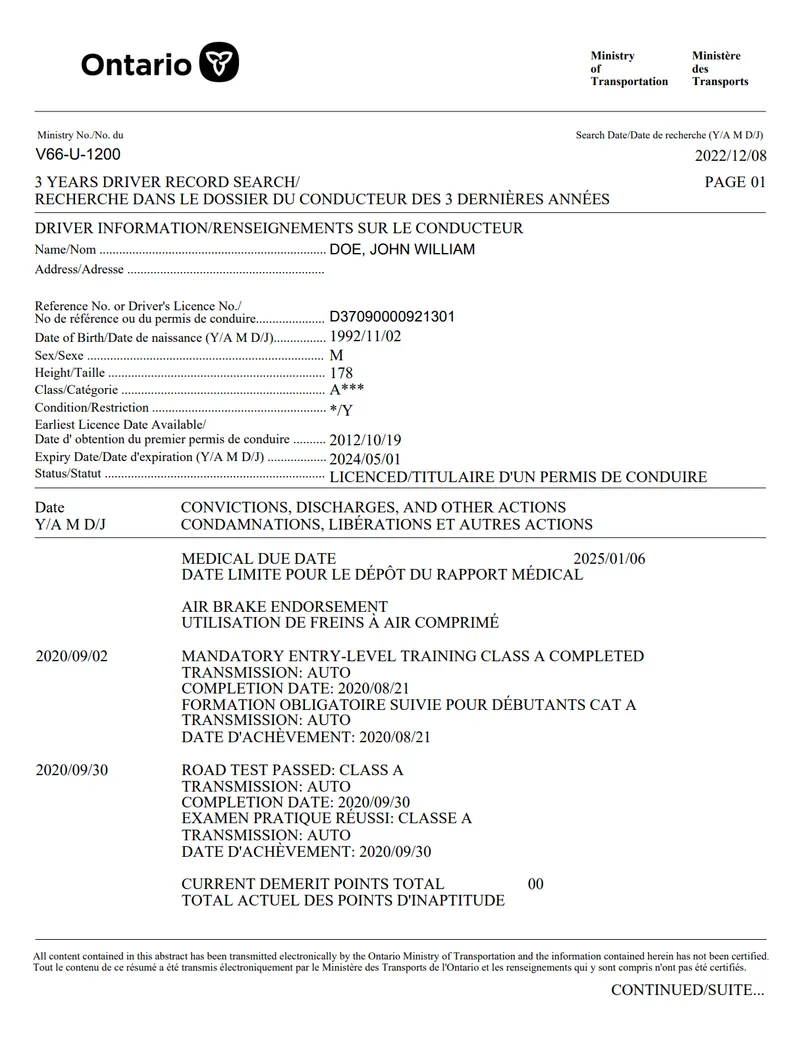
The header
The top of the page carries the Ontario wordmark and the Ministry of Transportation identification in English and French. Beneath it sit three things to look for:
- A ministry reference number identifying the form.
- The search date: the date the record was produced. This is the field an insurer or employer checks when they ask for a record issued within the last 30 days.
- The record title: for the standard product, “3 Years Driver Record Search”, alongside its French equivalent, and a page number.
Driver information
A labelled block identifying the licence holder. Every label appears in both English and French, which is why the document looks denser than it actually is.
- Name: printed surname first.
- Address: often blank. This is normal.
- Driver’s licence number: the 15-character number.
- Date of birth, in year/month/day order.
- Sex and height.
- Class: G, G2, AZ, DZ and so on.
- Condition or restriction: for example corrective lenses.
- Earliest licence date available: how far back the licensing record goes.
- Expiry date.
- Status: for example “LICENCED”.
Dates throughout use year/month/day. A date reading 2024/05/01 is 1 May 2024, not 5 January.
Convictions, discharges and other actions
The main body. Entries appear as a dated list, each with a description in English followed by the French equivalent.
What appears here is broader than convictions alone. Records commonly include medical review dates, endorsements such as air brakes, completed training and road tests passed. Seeing entries here does not automatically mean you have offences against your licence, a clean record can still list several administrative items.
If your record is entirely clear of convictions, this section is correspondingly short. What does and does not appear is covered in what shows on an Ontario driver abstract.
Current demerit points total
Near the foot of the record, stated plainly, often as 00.
Read this alongside the convictions section rather than on its own. Points expire before the convictions that produced them stop appearing, so a total of zero does not by itself mean a clear record; how long convictions stay on your record explains why.
The footer
Each page closes with a bilingual statement that the content was transmitted electronically by the Ministry of Transportation and has not been certified.
That line sometimes worries people who assume it undermines the document. It does not; it is simply what “uncertified” means, and it appears on every uncertified record. Insurers and employers requesting this version expect to see it. The difference between the two formats is set out in certified versus uncertified records.
Where a record runs to more than one page, the foot of each page is marked “continued”.
How to tell a genuine record
Four things to check on any abstract handed to you:
- Ministry letterhead and reference number in the header.
- Bilingual labelling throughout, genuine records are English and French on every field.
- A search date consistent with when the record was supposedly obtained.
- The electronic transmission footer on each page.
Employers reviewing candidate documents will find the section-by-section guide in how to read an Ontario driver abstract useful alongside this. And if what you need is your own copy of the document above, you can get an Ontario driving abstract online for $39.99, delivered by email.
Frequently asked questions
What does an Ontario driver abstract look like?
It is a bilingual English and French document on Ministry of Transportation letterhead. It opens with a driver information block listing name, licence number, date of birth, class and status, followed by a dated list of convictions and other actions, and finishes with a current demerit point total.
Is a driver abstract a PDF or a paper document?
The uncertified 3-year record is issued electronically and delivered as a PDF. Certified copies are physically produced and mailed, which is one of the main practical differences between the two.
Does an uncertified abstract look official?
Yes. It carries Ministry of Transportation letterhead, a ministry reference number and a search date. The footer states that the content was transmitted electronically and has not been certified, which is what "uncertified" means and is expected by anyone who requests one.
Why is my address blank on the abstract?
The address field is frequently blank on driver records. It is normal and does not mean the document is incomplete or invalid.
How many pages is a driver abstract?
It depends on how much is recorded against the licence. A clean record often fits on one page, while a record with several convictions runs longer. Multi-page records are marked "continued" at the foot of each page.