

How do you check your Ontario driving record for errors?
Get a current copy and read it against your own paperwork: your licence card, your tickets and any court documents. Check it in this order, because the first two checks catch the errors that matter most.
- Identity. Name, licence number and date of birth should match your card. The record prints your name surname first and your licence number without hyphens, and both are normal.
- Status and expiry. The status reads, for example, licensed, unlicensed or suspended. A suspension you did not know about is the most urgent line on the page, and checking your licence status explains what each status means.
- Convictions. Match each conviction to a ticket you recognize. The record shows the conviction date, which usually comes after the offence date on your ticket, so dates that do not match are not an error on their own. Dates run year/month/day, so 2024/05/01 is May 1, not January 5.
- Point total. Compare the current demerit point total with your convictions for offences in the last two years. Points count from the offence date, so use the date on your ticket, not the conviction date on the record.
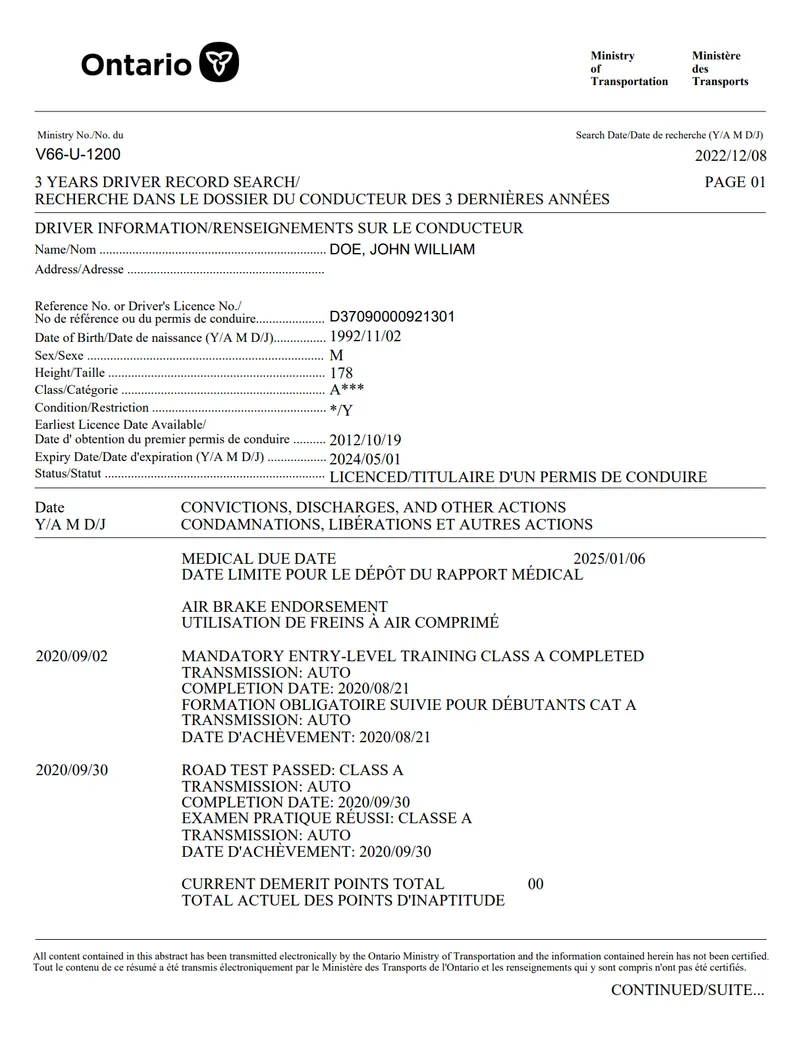
Not every line in that section is an offence. Road tests passed, air brake endorsements and completed training are listed there too. The guide to reading your drivers abstract walks through the layout field by field.
What looks like a mistake on a driving record but is not?
A blank address, a conviction for a ticket you paid, a conviction with zero points, and no collisions or parking tickets are all normal on an accurate record. Rule out the normal entries below before you call anyone.
Normal, not an error
- A blank address line, because the 3-year record leaves your address off
- A conviction for a ticket you paid, because paying the fine is a guilty plea
- A conviction with zero points beside it
- A conviction date later than the date on your ticket
- No collision listed, even one you were in
- No parking tickets, which are not reported to the record
- No red light camera tickets, which go to the vehicle owner
- No beginner driver education course, which belongs to the licence history
- Points from a ticket in another province, New York or Michigan
Worth querying
- A conviction you cannot match to any ticket
- A conviction for a charge that was withdrawn, dismissed or won at trial
- A conviction still listed well after an appeal was filed
- A suspension you were never told about
- An expired medical suspension still listed
- An active fine suspension after every fine and fee was paid
- A name, date of birth, sex or height that does not match your licence
A conviction can sit on the record while adding nothing to your total. A novice driver convicted of breaking a novice condition, or of an offence worth four or more points, has the points recorded as zero. When a court suspends your licence as part of the sentence, no points are recorded, except for handheld device, display screen and stunt or racing offences. And points stop counting two years after the offence date, while convictions from the past three years stay listed.
A total lower than you expected can be right too. Two convictions from the same incident, with no court suspension, record only the points for the conviction carrying the most points, and after a demerit point suspension the total drops to seven for a fully licensed driver or four for a novice. The guide to checking your demerit points covers the arithmetic.
Unpaid 407 tolls carry no demerit points, so they never add to your total. For the full rules, see which tickets show on your record and whether an abstract shows accidents.
What kinds of errors turn up on an Ontario driving record?
The usual ones are a conviction that is not yours, a conviction for a charge you beat or appealed, a suspension you never heard about, and personal details that do not match your card. Each has a usual cause and a usual place to take it.
| What you see | Possible cause | Who to contact |
|---|---|---|
| A conviction that is not yours | A ticket recorded under the wrong name or licence number | The court office that entered the conviction |
| A conviction you never knew about | A ticket or notice that never reached you, so the conviction was entered without a hearing | The court office, within 15 days of finding out, to apply to have it struck out |
| A conviction for a charge you beat | The court outcome and the record do not match | The court office that handled the charge, with your proof of the outcome |
| A conviction you have appealed | The Registrar has not been served with notice of the appeal, or the documents are still being processed | Your lawyer or paralegal, or the court office, to confirm the notice of appeal was served on the Registrar; the Ministry for processing questions |
| A point total that does not add up | Usually expired points, novice zero points or the same-incident rule; occasionally a recording mistake | The Ministry of Transportation, which determines demerit points |
| A suspension you were not told about | An unpaid fine in default, or a Ministry suspension letter that never reached you, for example after a move | The Ministry’s Driver Improvement Office; the court office for unpaid fines |
| An active fine suspension after paying | The reinstatement fee is unpaid, or another fine or suspension is outstanding | The court office to confirm every fine is paid, then the Ministry |
| Wrong name, date of birth, sex or height | Licence details recorded incorrectly | In person at a driver licensing office, with your current licence and, where required, original supporting documents |
Who corrects a driving record in Ontario: the court or the Ministry?
It depends on the entry. Under the Highway Traffic Act, the court reports driving convictions to the Registrar of Motor Vehicles, so a conviction you dispute generally goes back to the court that entered it. Demerit points, licence status and personal details sit with the Ministry of Transportation.
The courts
- A conviction you say is not yours
- A conviction entered without a hearing
- An appeal of the conviction
- Unpaid fines behind a fine suspension
Ministry of Transportation
- Your demerit point total, which the Ministry determines
- Suspension and reinstatement questions, through the Driver Improvement Office
- Name, date of birth, sex or height, changed in person at a driver licensing office
- Address changes, which can be made online
Your insurer
- Claims and conviction codes on your AutoPlus report
- AutoPlus is built from insurer data and its operator cannot edit entries
- Disputes go to the complaint officer or ombudsperson of the insurer that reported it
Commercial drivers have one more stop. An event on a CVOR Driver Abstract is a question for the Ministry’s CVOR office, and how to read a CVOR Driver Abstract covers that record.
How do you get an error on your driving record corrected?
Get the current record, pin down the exact entry, gather your proof and take it to the office that owns that entry. Then confirm the fix on a fresh copy.
Get a current copy of your record
Work from a dated record, not memory or last year’s copy. You can order your driving abstract online and have the PDF instantly.
Write down the exact entry
Note the date, the offence description and the points exactly as printed. Every office you contact will ask for them.
Gather your paperwork
Your licence card, the ticket, payment receipts and any court document showing the outcome, such as a withdrawal, a dismissal or an appeal filed. For a suspension, keep whatever shows it was lifted: a Notice of Suspension letter, a medical letter or an affidavit.
Take it to the office that owns the entry
Use the table above to find which office that is, and bring the entry and your proof with you.
Confirm it on a fresh record
The copy you hold never updates. Order a new record after the correction and check the entry is gone or changed.
What if a conviction on your drivers abstract is not yours?
Compare it with your own details and the ticket, then take it to the court office that entered it. A court’s notice of conviction to the Registrar includes the driver’s name, description and licence number, so a wrong number or name on a ticket can put someone else’s conviction on your record.
Start with your licence number, because that is what your record is tied to. It has 15 characters: one letter, then 14 digits. The letter is the first letter of your last name, and the 9th and 10th digits are the last two digits of your birth year. The guide to your Ontario licence number shows where each part sits.
Before you order, check the number against the front of your card, character by character. A swapped digit still looks like a real number.
Two other mix-ups come up:
- Your details differ from your card. Name, date of birth, sex and height are corrected in person at a driver licensing office, with your current licence and, where required, original supporting documents. A new card is mailed, and the old one is voided when it arrives.
- You changed your name or moved. Ontario expects you to tell the Ministry within six days. If you did not, a Ministry suspension letter may never have reached you, which is one way a suspension can show up on the record before you hear about it.
How do you confirm the error has been corrected?
Order a fresh record after the correction and check the entry yourself. A driving record is a snapshot of the day it was issued, so the copy you already hold will never change.
With an appeal, you do not have to wait for the decision. Once the Registrar has been served with notice of an appeal, the conviction and its points come off the record, or are never entered, unless the conviction is upheld.
Allow for processing. After an appeal is filed, the Ministry may take up to 15 business days, sometimes longer, to process the documents, and if the conviction led to a suspension, the status stays suspended meanwhile. A record ordered before the paperwork is processed will still show the old entry.
On the new record, check that:
- The search date at the top is after the correction
- The disputed conviction is gone, or now shows the right details
- The demerit point total matches your point offences from the last two years
- The status reads licensed, if a suspension was lifted
One thing will not disappear: most lifted suspensions stay on the record with their reinstatement for the three-year window. That is accurate, not a leftover error. The exception is an expired medical suspension, which the 3-year record leaves off.
Then send the new copy to anyone who saw the old one. An insurer holding a record with the mistake on it has no reason to look again until you replace it. The guide to drivers abstracts for insurance shows what they look at.
What should you do right now if you think your record is wrong?
Order a current copy first, so you can quote the disputed entry word for word.
If the record is clean, you have a copy ready for an insurer or employer. If it is not, you have the entry, its date and its points in writing. Get your Ontario driving record online for $39.99, delivered instantly by email.
We are an independent service, not the government, so we cannot change what is on your record. You get the record exactly as it stands on the day you order.
Wondering how long an accurate entry will stay? See whether your driving record resets, and for a full list of what the record carries, see what is on an Ontario drivers abstract.
Frequently asked questions
Can the Ministry of Transportation remove a conviction from my record?
A conviction reaches your record because a court reports it, so a conviction you dispute is generally dealt with through that court, by a reopening or an appeal. The Ministry of Transportation administers demerit points and licence status. A lawyer or paralegal can advise on your case.
How long do I have to challenge a conviction I did not know about?
If you were convicted without a hearing, for example over a ticket that never reached you, you can apply to have the conviction struck out within 15 days after becoming aware of it. The application is filed at the court office.
I paid the ticket. Should it be on my record?
Yes, if it was a ticket for a driving offence given to you as the driver. Paying the set fine counts as a guilty plea and a conviction, so the conviction and any demerit points are recorded. Parking tickets are not reported to the record, and red light camera tickets go to the vehicle owner instead.
Why is the address blank on my drivers abstract?
The 3-year driver record does not include your address, to protect your privacy. A blank address line is normal and there is nothing to correct.
If my appeal succeeds, do the demerit points come off too?
Yes, and sooner than that. Once the Registrar of Motor Vehicles has been served with notice of the appeal, the conviction and its demerit points are not entered on your record, or are removed, and they go back on only if the conviction is upheld.
My insurer mentioned a claim that is not on my abstract. Is my record wrong?
Probably not. Collisions and claims are not among the contents of the 3-year driver record. Insurers share claims history through AutoPlus, which is built from insurer data, and an entry there is disputed with the insurer that reported it.
Will the copy I already have update once the error is fixed?
No. A driver record is a snapshot of the day it was issued. Only a record ordered after the correction will show it, so get a new one before you send it to an insurer or employer.
How quickly can I see what is on my record now?
Order your 3-year driver record and the PDF arrives in your inbox instantly after payment, for $39.99. Occasional delays can occur.
Sources: How convictions reach the record, and the exclusion for parking: Highway Traffic Act, section 210. Fine-default suspensions and reinstatement: Highway Traffic Act, section 46, and Provincial Offences Act, section 69. Paying or not answering a ticket, and striking out a conviction entered without a hearing: Provincial Offences Act, sections 8, 9 and 11. Demerit points, appeals and the same-incident rule: Ontario Regulation 339/94 (Demerit Point System). Camera penalties: Ontario Regulation 355/22. Novice zero points, record contents, licence detail changes and appeal processing: Ministry of Transportation published guidance and the MTO Driver’s Handbook. Insurance history: CGI’s AutoPlus consumer guidance.