

What is on a CVOR Driver Abstract?
It shows your licence details (class, condition, expiry date, status and medical due date) and up to five years of your convictions, inspections and some collisions from driving commercial vehicles in Ontario.
On it
- Your name and licence number
- Class, condition, expiry date and status
- Your medical due date
- Convictions, moving and non-moving
- Inspections
- Collisions tied to a safety-related conviction of yours
Not on it
- Convictions from your personal vehicle
- A demerit point total
- Events outside Ontario
- Collisions with no safety-related conviction, according to its printed note
The CVOR Level 1 and Level 2 abstracts describe a carrier, not a driver; the Level 1 vs Level 2 guide covers those. The fastest way to know what your own record says is to get your CVOR Driver Abstract and read it with this page open.
What does each section of a CVOR abstract mean?
Read it top to bottom: the date, the licence block, the printed scope note, then the event list. The licence block tells a carrier whether you can legally drive the truck. The event list tells them how you have driven it.
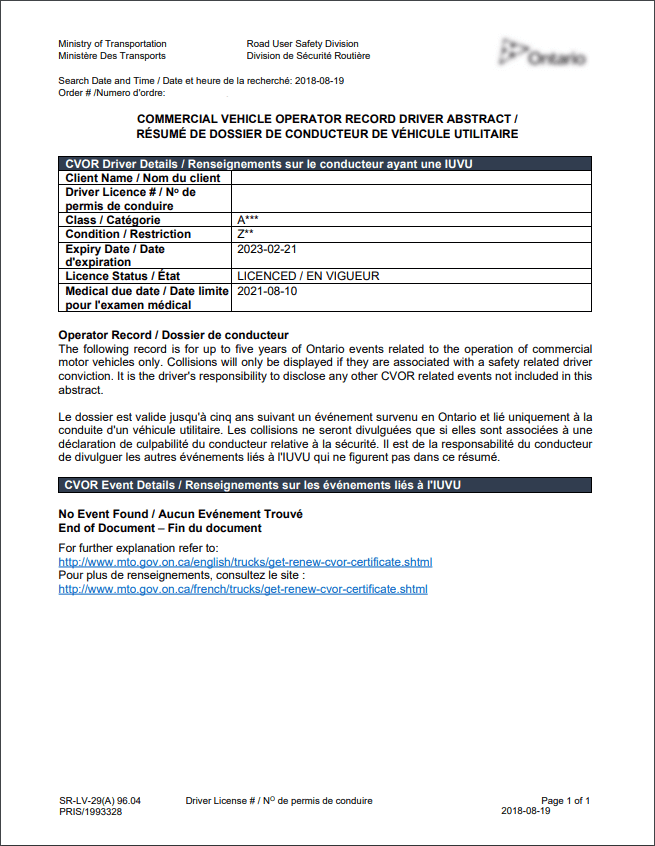
| Part of the abstract | What it tells you | What to check |
|---|---|---|
| Header | The Search Date and Time: the day the record was produced. | Recent enough for whoever asked. An older copy misses anything recorded since. |
| Client name and licence number | Whose record it is. The licence number is the 15-character Ontario number. | Both match your licence card exactly. |
| Class | Your licence class, such as A for tractor-trailers or D for heavy trucks. | It covers the vehicle you will be driving. |
| Condition / Restriction | Endorsements and limits on the licence, such as Z for air brakes. | Z is there if the equipment has air brakes. Check for any restriction that limits the job, such as R on a Class A. |
| Expiry date | When the licence expires. Ontario licences are valid for five years. | Not lapsed, and not about to. |
| Licence status | Whether the licence is in force, for example licensed or suspended. | Licensed. Anything else has to be resolved before you drive. |
| Medical due date | When your next commercial medical report is due. | Still in the future, with time left to file the next report. |
| Operator Record note | The scope of the record and what it leaves out. | Read it before the event list, so a short list is not misread. |
| CVOR Event Details | Each conviction, collision and inspection, with a description and a microfilm reference number. | "No Event Found" means nothing is listed for the period covered. |
| Footer | Page numbering and the date again. | Send every page, not just the first. |
How do you read the class, conditions and medical due date?
The licence block answers one question: can this person legally drive this vehicle today? Class says what you may drive, the condition line says how, and the medical due date says how long that lasts.
Class
Class A covers any tractor-trailer combination. Class D covers a motor vehicle over 11,000 kg, or any truck or combination where the towed vehicle is not over 4,600 kg. Bus drivers hold B, C, E or F.
Condition / Restriction
Z is the air brake endorsement, required to drive any vehicle with air brakes. R on a Class A (written AR) means restricted: no trailers with air brakes, no full-size tractor-trailer, no doubles. W means you may not operate a commercial vehicle in the United States, because of a hearing impairment, a history of seizures or vision in one eye.
Since July 1, 2022, a Class A or AR road test taken in a truck without a manual transmission of at least eight forward gears with high-low range leads to a manual transmission restriction, noted on the driver record and the licence.
Expiry date and status
An Ontario licence is valid for five years, and driving on an expired or suspended one is illegal. A carrier wants to see a status of licensed and an expiry date that is not about to arrive.
Medical due date
Every Class A, B, C, D, E and F licence holder files a medical report on a schedule set by age. The date on your abstract is the next deadline.
| Driver age | Medical report required |
|---|---|
| Under 46 | Every five years |
| 46 to 64 | Every three years |
| 65 and over | Every year |
Not sure when your medical is due? It is printed on the abstract, so check your CVOR Driver Abstract before the date catches up with you.
The full list of classes and endorsements, from G to A, is in Ontario licence classes explained.
What is the difference between inspections, collisions and convictions on a CVOR abstract?
A conviction is a finding that you broke a law while driving commercially. An inspection is a commercial vehicle safety inspection relating to you as the driver. Collisions are the narrowest of the three, as the table shows.
| Event | What puts it on the abstract | What to know |
|---|---|---|
| Conviction | A conviction for an offence committed while operating a commercial vehicle in Ontario, moving or non-moving. | Paying the ticket counts as a conviction. The same conviction is also recorded against the carrier you were driving for. |
| Inspection | An inspection recorded while you were operating a commercial vehicle in Ontario. | An inspection on its own is not a conviction. A carrier's own CVOR record counts every fleet inspection, with or without defects. |
| Collision | Per the printed note, only a collision associated with a safety-related driver conviction. | That limit belongs to the driver abstract. A carrier's own CVOR record lists reportable collisions. |
Ignoring a ticket gets you to a conviction too. If you do nothing for 15 days after the ticket is served, a conviction can be entered without a hearing.
Each event comes with a description and a microfilm reference number. The description tells you what happened. Keep the reference number handy if you ask the CVOR office about the entry. If you are not sure which of the three your own record holds, your CVOR abstract answers that before an interview does.
How do carriers read a CVOR Driver Abstract?
A carrier reads your CVOR abstract as a preview of its own record, because convictions picked up by a driver operating under its CVOR certificate are recorded against the carrier too. Ontario tracks each operator’s violation rate and safety rating, and an Unsatisfactory rating suspends or cancels operating privileges across Canada.
Before it gets that far, the ministry can step in with disciplinary letters, interviews, audits, fleet size limits and plate seizure. So a careful carrier checks a new driver’s abstract before that driver can add anything to its record. The check covers six points.
The date and the name
Is the abstract recent, and do the name and licence number match the driver applying?
Class and conditions against the job
A for tractor-trailers, D for heavy trucks, Z if the equipment has air brakes. A W condition rules out US runs, and a manual transmission restriction matters if the fleet runs manual trucks.
Status and medical due date
Licensed, and a medical due date that will not lapse halfway through the season.
The event list
Each conviction, inspection and collision listed, read for how recent, how serious and whether there is a pattern.
The 3-year record alongside it
Convictions in a personal vehicle and the demerit point total are on the 3-year driver record, so a carrier that wants the full picture may ask for both.
Then again next year
The provincial safety manual for operators says to get a driver abstract at hiring and at least every year after, and driver abstracts are checked in a facility audit.
Your record becomes part of their file, and the more of it you have seen first, the easier the interview. More on the hiring side is in drivers abstracts for truck drivers.
How is a CVOR abstract different from the 3-year drivers abstract?
The CVOR Driver Abstract covers five years of commercial driving in Ontario. The 3-year drivers abstract covers three years of convictions, suspensions and reinstatements, whatever you were driving, and adds your demerit point total. They overlap, but neither replaces the other.
CVOR Driver Abstract
- Up to five years of events
- Commercial-vehicle driving in Ontario only
- Convictions, inspections and some collisions
- Class, condition, expiry date, status and medical due date
- No demerit point total
3-year driver record
- The past three years
- Highway Traffic Act and Criminal Code convictions, whatever you were driving
- Suspensions, reinstatements and active fine suspensions
- Your demerit point total
- Does not list collisions
A speeding conviction from your own car on a Saturday is a 3-year record matter. The same conviction in a loaded tractor-trailer in Ontario can show on both, as long as it falls inside each record’s window.
Not sure which one you were asked for? The CVOR vs driver abstract comparison sets them side by side, and you can get your 3-year driver record online the same way as the CVOR one.
What if your CVOR abstract shows an event you do not recognize?
Start with the description and reference number on the entry, then take it to whoever can change it. Questions about an event on a CVOR abstract go to the Ministry of Transportation’s CVOR office, while a conviction you dispute is generally a matter for the court that entered it.
If you were convicted without a hearing, for example over a ticket you never received, you can apply to have the conviction struck out within 15 days after you become aware of it. A lawyer or paralegal can advise on that and on appeals.
Once anything is corrected, get a fresh abstract and confirm it reads the way it should before a carrier sees it. The guide on what to do if your driving record is wrong covers the 3-year record side.
When should you get a fresh CVOR Driver Abstract?
Get a new one whenever someone is about to rely on it. An abstract is a snapshot dated the day it was produced, so an old copy shows an old record.
- Applying to a carrier, or starting with a new one
- Your carrier’s yearly driver file review
- After a ticket is resolved, to confirm what was recorded
- After a medical downgrade is fixed, to show your class is back
- After an old event moves outside the five-year window
- Before an interview, so nothing on it surprises you
You can order your Ontario CVOR Driver Abstract online for $39.99. One short form, no account, and the five-year PDF is delivered instantly by email. Occasional delays can occur. The step-by-step ordering guide lists what to have ready.
Frequently asked questions
Does every collision show on a CVOR Driver Abstract?
Not necessarily. The note printed on the abstract says a collision is shown only when it is tied to a safety-related conviction of the driver.
What does "No Event Found" mean on a CVOR abstract?
It means the abstract lists no commercial-driving convictions, inspections or qualifying collisions for the period it covers. It is what a clean CVOR Driver Abstract looks like.
Do tickets from my own car show on my CVOR abstract?
No. The CVOR Driver Abstract only covers time spent operating commercial vehicles in Ontario. A conviction from your personal vehicle shows on your 3-year driver record instead.
Does a CVOR Driver Abstract show my demerit points?
No. The CVOR Driver Abstract has no demerit point total. Your current total is on the 3-year driver record.
Does my CVOR abstract show tickets from other provinces or the US?
No. It only includes information from when you were operating a commercial vehicle in Ontario. Separately, certain convictions in another province or territory, New York or Michigan can add demerit points to your Ontario licence, and your point total shows on the 3-year driver record.
Can a carrier get my CVOR abstract without asking me?
Yes. The CVOR Driver Abstract is available to the general public. The provincial safety manual for operators also tells carriers to collect a current abstract from each driver, or a signed release allowing them to obtain it.
How long do events stay on CVOR records?
The CVOR Driver Abstract covers up to five years of events. On a carrier's CVOR record, every collision, conviction and inspection stays for five years from the date of the event.
How quickly can I get my CVOR Driver Abstract?
Fill in one short form and the five-year PDF is delivered instantly by email after payment, for $39.99. Occasional delays can occur.
Sources: CVOR Driver Abstract contents follow the Ministry of Transportation’s own descriptions of the record, the note printed on the abstract and its Commercial Vehicle Operators’ Safety Manual (February 2022 edition). Paying a ticket as a conviction (section 8), convictions entered without a hearing (section 9) and the 15-day application to strike one out (section 11) follow the Provincial Offences Act. Demerit points for convictions in another province or territory, New York or Michigan follow Ontario Regulation 339/94 and MTO’s demerit point guidance. Licence validity follows MTO’s licence renewal rules. Licence classes, endorsements, CVOR record retention and commercial medical reporting follow the MTO Official Driver’s Handbook, the Official Truck Handbook and Ontario’s medical standards for commercial drivers.