
What are the driver’s licence classes in Ontario?
Ontario uses letters for what you may drive: G for everyday vehicles, M for motorcycles, and A, B, C, D, E and F for commercial vehicles. G1, G2, M1 and M2 are not separate vehicle types but the learning stages on the way to a full G or M.
Most classes include one or more others, so a Class A driver does not need a separate Class D or G. The chart below follows the Ministry of Transportation’s own classification.
| Class | What it lets you drive | Also covers |
|---|---|---|
| A | Any tractor-trailer combination | Class D and G vehicles |
| B | Any school purposes bus | Class C, D, E, F and G vehicles |
| C | Any regular bus | Class D, F and G vehicles |
| D | A motor vehicle over 11,000 kg gross weight or registered gross weight, or any truck or combination where the towed vehicle is not over 4,600 kg | Class G vehicles |
| E | Any school purposes bus with a maximum capacity of 24 passengers | Class F and G vehicles |
| F | Any regular bus with a maximum capacity of 24 passengers, and ambulances | Class G vehicles |
| G | Any car, van or small truck, or a vehicle and trailer up to 11,000 kg combined where the trailer is not over 4,600 kg | No other class |
| M | Any motorcycle, including motor tricycles, limited-speed motorcycles (scooters) and mopeds | A Class G vehicle, under the conditions that apply to a G1 |
What can you drive with a Class G licence?
A full G covers everyday driving and light towing, but not motorcycles, air brakes or heavy trucks.
A full Class G covers
- Cars, vans and small trucks
- A vehicle and trailer up to 11,000 kg combined, with the trailer not over 4,600 kg
- A recreational vehicle up to 11,000 kg, or up to 14,000 kg with the T (RV) endorsement
You need more than a G for
- Motorcycles, limited-speed motorcycles and mopeds (Class M)
- Tractor-trailers, or any trailer over 4,600 kg (Class A)
- Heavy trucks (Class D)
- Any vehicle with air brakes (Z endorsement)
If an employer wants proof of a full G rather than a G2, Ontario’s online licence check will not show it: it gives your licence status, not your class. Your 3-year driver record does, along with your conditions and history.
How do G1, G2 and a full G licence work?
Ontario licenses new car drivers in two stages, G1 then G2, with a road test at the end of each. Getting from G1 to a full G takes at least 20 months.
Get your G1
You must be at least 16 and pass a vision test and a knowledge test. G1 rules include zero blood alcohol, a fully licensed front-seat companion with at least four years of experience, no driving between midnight and 5 a.m., and no 400-series highways or high-speed expressways unless you are with a driving instructor.
Hold the G1 for 12 months, or 8 with an approved course
An approved beginner driver education course of at least 40 hours cuts four months. The G1 exit road test then moves you up to G2.
Drive on a G2 for at least 12 months
You can drive alone, with zero blood alcohol. Drivers 19 and under also have passenger limits between midnight and 5 a.m.
Pass the G2 exit road test for your full G
This second road test makes you fully licensed. You have five years to finish the whole process, or you start over.
Every driver 21 and under must also have a zero blood alcohol level, whatever their class. The G1 and G2 drivers guide covers what a new driver’s record looks like.
How do motorcycle licences work in Ontario?
Motorcycles have their own graduated system: M1, then M2, then a full Class M. Unlike the commercial classes, you can get a motorcycle licence without first holding a full G.
| Licence | What it allows | Key rules and timing |
|---|---|---|
| M1 | Riding a motorcycle under strict conditions | Zero alcohol, daylight only, no passengers, and no roads over 80 km/h except listed highways. Valid for 90 days, and you must wait at least 60 days before the first road test. |
| M2 | Riding a motorcycle with a zero blood alcohol level, and driving a Class G vehicle under G1 conditions | Second road test after 22 months, or 18 with a recognized Motorcycle Safety Course. Up to five years from getting the M2 to finish. |
| M | Any motorcycle, scooter or moped | The full licence, earned with the second road test. |
What are Class A, B, C, D, E and F licences for?
They are Ontario’s commercial classes. A is for tractor-trailers, D for heavy trucks, B and E for school buses, C and F for regular buses, with F also covering ambulances.
Class A and D share the same entry rules: you must be at least 18, hold a valid Ontario G or higher, pass a knowledge test, meet vision standards and provide a medical certificate. Class A adds a mandatory entry-level training course before the road test.
Class A licence in Ontario
A Class A licence lets you drive any tractor-trailer combination, plus Class D and G vehicles, but not a bus carrying passengers, a motorcycle or a moped.
- From January 1, 2027, you must have held a Class G or higher for at least 6 months before the Class A road test.
- A Class A or AR road test taken in a vehicle without a manual transmission of at least eight forward gears with high-low range brings a manual transmission restriction, noted on your driver record and licence.
Class D licence in Ontario
Class D is the heavy truck licence. Since July 1, 2018, Class D holders have had to file regular medical reports, the same as the other commercial classes.
Add the Z endorsement and it becomes a DZ, which covers heavy trucks with air brakes. A Class D with the Q condition is the RV-only version: a recreational vehicle of any weight, but no other Class D vehicles.
Missed a medical report? An Ontario drivers abstract shows the class and status you hold today.
Drivers of vehicles that need an A to F licence or a CVOR must also have zero alcohol in their system. The guide for truck drivers covers what carriers ask for when you apply.
What does the Z air brake endorsement mean?
The Z endorsement is what you need to drive any vehicle with air brakes or air-over-hydraulic brakes, whatever your class. You earn it through an air brake endorsement course or by passing the tests at a DriveTest centre.
AZ is a Class A with the Z endorsement, and it lets you drive any truck and tractor-trailer combination, double trailers, and everything covered by Class G, Class D and restricted Class A. DZ is a Class D with the same endorsement, for heavy trucks with air brakes.
Ontario’s online licence check will not prove the Z to a carrier: it shows no licence class and no endorsements, and the Ministry points commercial operators to the driver record instead. Your 3-year record lists the air brake endorsement, and you can get your driving record online in one short form.
What do the letters after an Ontario licence class mean?
A letter next to your class is either an endorsement, which adds something you may drive, or a condition, which limits how or what you drive. The common ones:
| Letter | Type | What it means |
|---|---|---|
| Z | Endorsement | You may drive vehicles with air brakes or air-over-hydraulic brakes (AZ, DZ) |
| T | Endorsement | With a full E, F or G, you may drive a recreational vehicle up to 14,000 kg (in effect since July 1, 2025) |
| R | Condition on Class A | Restricted Class A (AR): smaller combinations such as recreational, horse or utility trailers. No air-brake trailers, full-size tractor-trailers or double trailers |
| Q | Condition on Class D | Recreational vehicles of any weight only, no other Class D vehicles |
| L | Condition on M or M2 | A limited-speed motorcycle or moped only. With an M2, the vehicle cannot go faster than 70 km/h and you stay on roads with a limit of 80 km/h or less |
| M | Condition on M or M2 | A motor tricycle (three-wheeled motorcycle) only |
| I | Condition | Ignition interlock: only vehicles fitted with an approved interlock device |
| P | Condition | No alcohol or drugs in your system when driving, for at least 6 months after an interlock condition ends (impaired driving offences on or after July 1, 2026) |
| W | Condition | No commercial driving in the United States, because of a hearing impairment, a history of epilepsy or seizures, or monocular vision |
Your record can also carry conditions that are not in this table, such as a requirement to wear glasses or contact lenses to drive. Not sure which apply to you? Your 3-year driving record lists your conditions and endorsements.
Where does your licence class show on your driving record?
Your class sits in the driver information block at the top of your 3-year driver record, with your licence number, expiry date and status, and the Condition/Restriction line right below it. Endorsements such as air brakes can be listed further down the record.
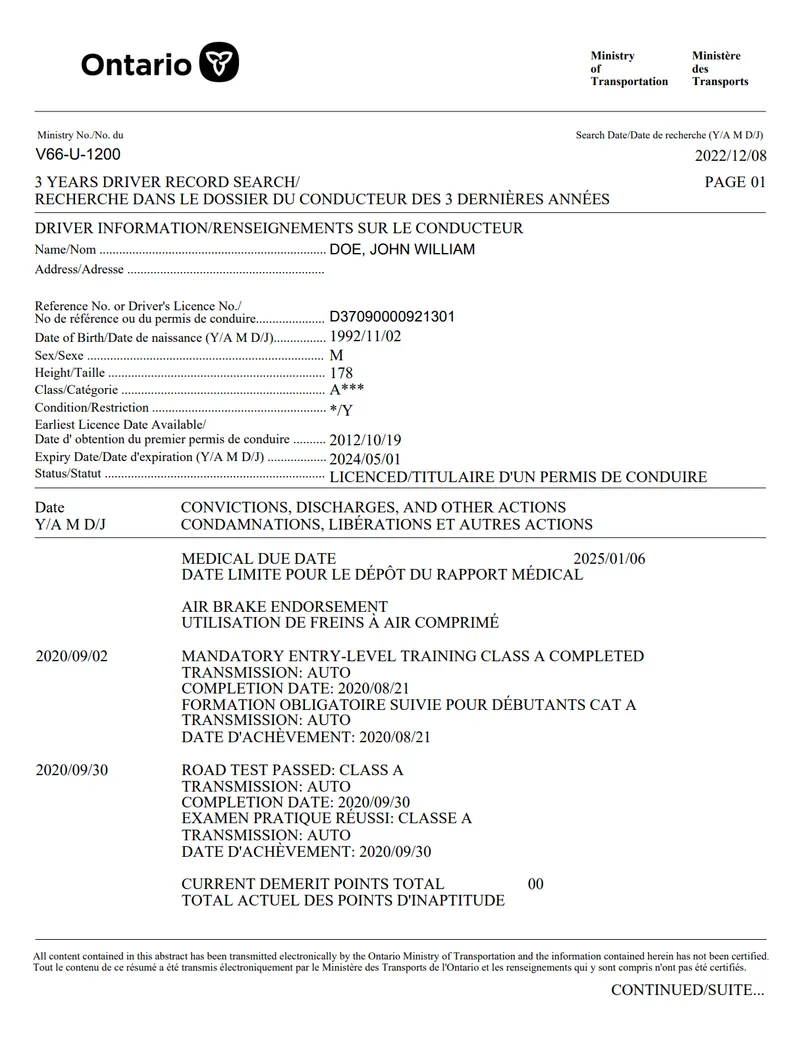
Your class also sets your demerit limits. Novice drivers (G1, G2, M1, M2 and the L versions) face a first suspension of 60 days at 9 or more points, fully licensed drivers a 30-day suspension at 15 or more, and a full G held with an M2 is measured against the full-licence limits. See how demerit points work and everything else on a drivers abstract.
To see your own Class and Condition/Restriction lines, order your Ontario driving record. It arrives in your inbox instantly after payment.
Which driving record should you order for your licence class?
For a G1, G2, G, M or any other class, start with the 3-year driver record: it is Ontario’s most popular driver record and the one commonly used for employment. Commercial drivers may also need the five-year CVOR Driver Abstract, which covers their time driving commercial vehicles in Ontario.
3-year driver record
- Licence class, status and expiry date
- Conditions and endorsements, including Z
- Earliest licence date available
- Your current demerit point total
- Convictions, suspensions and reinstatements from the past 3 years
CVOR Driver Abstract
- Licence class, condition, status and expiry date
- Medical due date
- Five years of collisions, safety-related offences, convictions and inspections
- Covers your commercial driving in Ontario only
The Ministry’s safety manual tells carriers to get a driver abstract when they hire a driver and at least once a year after that. The CVOR vs driver abstract comparison sets the two side by side, and the Ontario CVOR Driver Abstract page covers the commercial record.
Whatever your class, order your driving abstract online now and see the class, conditions and history on your record before an insurer or employer does.
Frequently asked questions
Is a G2 a full licence in Ontario?
No. G2 is the second stage of graduated licensing: you can drive alone, but novice conditions such as zero blood alcohol apply until you pass the G2 exit road test, at least 12 months after getting your G2.
How long is an Ontario driver's licence valid?
An Ontario driver's licence is valid for 5 years, and a renewal notice may arrive by mail or email about 2 or 3 months before it expires. An M1 is different: it is valid for only 90 days.
Can I renew an expired G1 or G2 licence?
No. Once a G1, G2, M1, M2 or M2 with L condition licence expires it cannot be renewed, although an extension may be possible if you booked a road test before the expiry date. Without one, you have no licence and must reapply from Level One.
What do you have to declare when applying for a G or M licence?
Since May 11, 2026, applicants for a Class G or M licence must declare that Ontario is their primary residence and that their presence in Canada is legal. Commercial classes A to F also require documents showing you are eligible to work.
Can I ride a motorcycle with a G licence in Ontario?
No. A Class G covers cars, vans and small trucks, while any motorcycle, scooter or moped needs a Class M. You can earn an M through M1 and M2 without first holding a full G.
What licence do I need to drive an RV in Ontario?
A full G covers a recreational vehicle up to 11,000 kg, or up to 14,000 kg with the T (RV) endorsement. Above that you need a Class D, and a Class D with the Q condition is an RV-only version that covers recreational vehicles of any weight.
Does an AZ licence let me drive DZ trucks?
Yes. A full AZ covers any truck or tractor-trailer combination, including double trailers, plus everything in Class G, Class D and restricted Class A, all with air brakes.
How can I show an employer which licence class I hold?
Give them your driver record: it lists your licence class, status, expiry date, conditions and endorsements. Order your 3-year record for $39.99 and it arrives in your inbox instantly after payment. Occasional delays can occur.
Sources: Licence classes, endorsements, conditions and graduated licensing follow the Highway Traffic Act and the Ministry of Transportation’s Driver’s Handbook and Truck Handbook, and Ministry of Transportation guidance on ignition interlock and commercial driver medical standards. Demerit point limits for novice and fully licensed drivers come from Ontario Regulation 339/94 (Demerit Point System).