

Does a driver abstract show your G1, G2 and G dates?
Partly. It shows the class you hold now and one date, the earliest licence date available. The date of each step from G1 to G2 to G is not among its listed contents.
Ontario describes the 3-year record as driver identification details, your demerit point total, and three years of convictions, suspensions and reinstatements. Your licence class sits in the identification block. A timeline of how you got there does not.
What your 3-year record shows about your licence
- Your current licence class, such as G1, G2, G or M
- The earliest licence date available on your file
- Your licence expiry date
- Your status: licensed, unlicensed or suspended
- Conditions and endorsements, such as corrective lenses or air brakes
- Your name, licence number, date of birth, sex and height
What it does not show
- A full timeline of class changes (G1 to G2, G2 to G); these are not among its listed contents
- Licence renewals and replacements
- Beginner driver education (driver's ed) course completion
- Your address
- Expired medical suspensions
The record that tracks every class change, renewal and replacement is the driver’s licence history, and it notes driver’s ed too. What it leaves out matters just as much: it has no demerit point total and no convictions or suspensions.
When someone needs to know what licence you hold and how you have been driving, the 3-year driver record answers both. The guide to drivers abstract vs licence history sets the two records side by side.
What does the earliest licence date on your abstract mean?
It is the earliest licence date your Ontario record has available, printed in the driver information block. It is the date to point to when someone asks how long you have been licensed, but it is not promised to be the first day you ever held a licence.
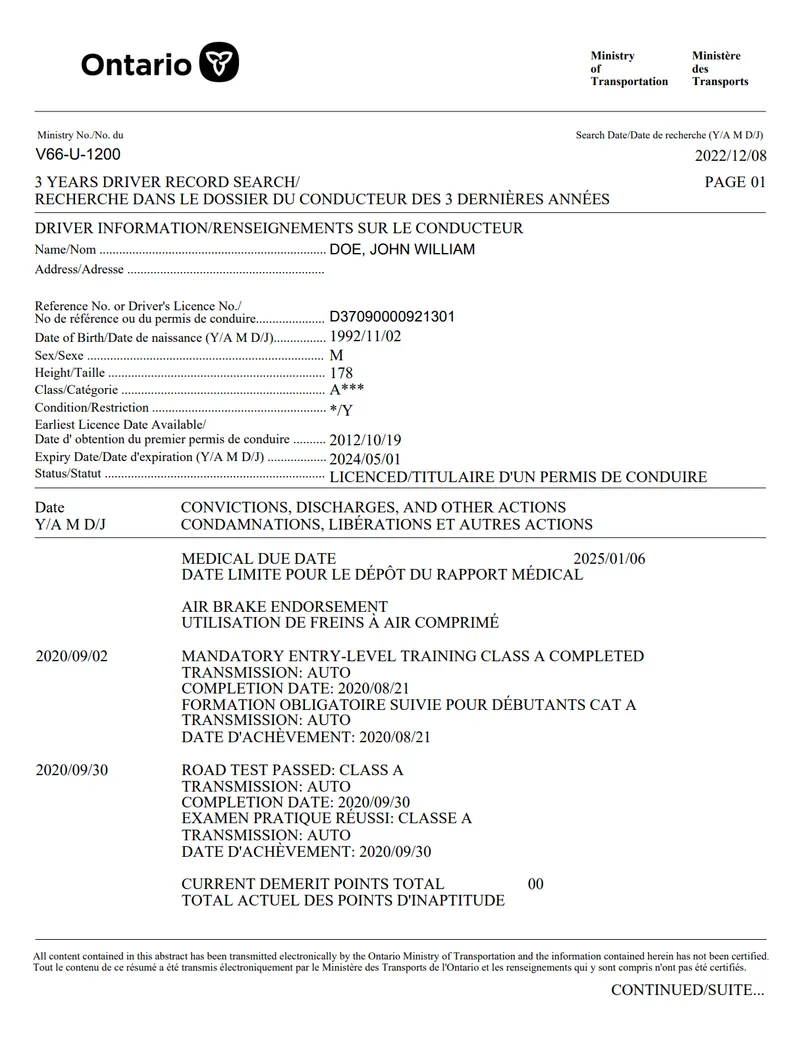
The wording matters. Ontario calls the field the earliest licence date available, not your first licence date, so read it as the earliest date on file.
If the date you remember and the date on file differ, you want to know before the person reading your record finds out. Quote the date as printed, or sort out the difference first.
Every other field is explained in what is on an Ontario drivers abstract, and new drivers can read what a novice record carries in drivers abstracts for G1 and G2 drivers.
How long do G1 and G2 last, and what does the record show at each stage?
Getting from a G1 to a full G takes at least 20 months with an approved driver’s ed course (8 months on a G1, then at least 12 on a G2), or at least 24 months without one. At every stage, your 3-year record shows the class you hold now.
| Stage | How long it lasts | What you can drive | What your 3-year record shows |
|---|---|---|---|
| G1 (Level One) | 12 months, or 8 months after an approved beginner driver education course | A car, only with a fully licensed companion who has at least four years of driving experience | Class G1, your earliest licence date available, expiry date and status |
| G2 (Level Two) | At least 12 months before the G2 exit road test | A car without a companion, subject to conditions such as zero blood alcohol | Class G2 and your earliest licence date available. The licence history is the record that lists class changes |
| Full G | Reached by passing the G2 exit road test | Any car, van or small truck | Class G and your earliest licence date available. A full timeline of your class changes is on the licence history |
Your class tells a reader where you are in graduated licensing. The earliest licence date tells them roughly how long you have been at it. Insurers weigh how long you have been licensed, so on a quote, both lines count.
Every class, from G through the commercial truck and bus classes, is laid out in the guide to Ontario licence classes.
Does a driver abstract show driver’s ed?
No. Ontario leaves beginner driver education course completion off the 3-year driver record. Graduating from an approved course is noted on your driver’s licence history instead.
- 40 hoursMinimum length of an approved course20 in class, 10 in the car, 10 flexible
- 4 monthsCut from the G1 stage8 months on a G1 instead of 12
- 20 monthsFastest route from G1 to full GWith the course; at least 24 without it
The licensing payoff from driver’s ed is time: you can take your G1 road test four months sooner. The course itself leaves no entry on the 3-year record, however recently you finished it.
So when someone specifically needs proof of driver’s ed, the 3-year record is the wrong document; the licence history is where completion is noted. Everything else people usually ask about, your class, status, points and convictions, is on your Ontario drivers abstract.
Why do insurers ask about driver’s ed and how long you have been licensed?
Because both feed your premium. Ontario’s insurance regulator counts how long you have been licensed and any driver training as part of the driving record insurers price, alongside previous accidents, speeding tickets and other convictions.
The Financial Services Regulatory Authority of Ontario (FSRA) puts the rule plainly: the better your record, the lower your premium. Premiums for the same driver can still differ from one insurer to the next.
Ontario describes the licence history as a record commonly used for vehicle insurance, and that fits: it answers the experience questions, class changes and driver’s ed. It cannot answer the conviction questions, because it carries no convictions, suspensions or points.
Those come from the 3-year record. The standard Ontario application asks for every conviction from the last three years, the same window your record covers, so read your drivers abstract before you fill in the form and make sure your answers match it.
Experience from abroad has its own rule. If a driver has been licensed in Canada for less than 6 years, the standard application says driving experience in other countries may be recognized when proof of the other licensing and insurance is attached. More in drivers abstracts for insurance.
How do you prove driving experience in Ontario?
Match the document to the question. Your 3-year driver record shows your class, your earliest licence date available and your last three years of driving; the licence history shows class changes and driver’s ed; insurance history comes from insurers, not the Ministry of Transportation.
| What you need to show | Where it is recorded | Good to know |
|---|---|---|
| How long you have been licensed | 3-year driver record: earliest licence date available | The earliest date on file, not always your first-ever licence |
| The licence class you hold today | 3-year driver record: class, conditions and endorsements | Shows G1, G2, G or a commercial class, plus conditions such as air brakes |
| A clean recent record | 3-year driver record: convictions, suspensions and demerit point total | Covers the past three years |
| When you moved from G1 to G2, or G2 to G | Driver's licence history: class changes | Has no convictions, suspensions or points |
| That you completed driver's ed | Driver's licence history | Noted when you graduate from an approved beginner driver education course |
| Driving experience from another country | Proof of the other licensing and insurance | Ontario insurers may recognize it if you have been licensed in Canada under 6 years |
| Insurance policies and claims | AutoPlus, the insurance industry database | Built from insurer data, not kept by the Ministry of Transportation |
The licence history can only be ordered by you or a Canadian law enforcement agency. The 3-year record can be ordered by anyone with your licence number, and it is the most popular Ontario driver record and is commonly used for employment. The difference between your driving record and your insurance history is covered in drivers abstract vs AutoPlus.
Moving out of Ontario raises the same question with more money riding on it. B.C.’s public insurer, ICBC, credits up to 15 years of outside driving experience toward insurance discounts on proof of the date you were first licensed, and learner time does not count. ICBC decides which Ontario document it accepts, so confirm with it first. The guide to moving out of Ontario with your driving record covers what other provinces ask for.
How do you check the licence dates on your own record?
Order your 3-year driver record and read the driver information block at the top: class, conditions, earliest licence date available, expiry date and status. It is $39.99, paid once, and the PDF arrives by email instantly after payment.
Have your licence number ready
It is on the front of your card: 15 characters, one letter followed by 14 digits.
Order your 3-year record
One short form and no account. The PDF arrives in your inbox instantly after payment. Occasional delays can occur.
Read the driver information block
Check your class, conditions, earliest date on file, expiry date and status against what you plan to write on the application.
Sort out anything that looks wrong first
A wrong class or date is worth fixing before an insurer or employer relies on it. The guide to errors on your driver abstract explains who corrects what.
A minute on the form shows you the licence class and earliest licence date anyone who orders your 3-year record will see. Order your driving abstract online for $39.99, with no account and no subscription.
Frequently asked questions
Does my driver's abstract show the date I got my full G?
Do not count on it. The 3-year record shows that your class is G and gives your earliest licence date available, but class changes are not among its listed contents. The record that lists every class change, such as G2 to G, is the driver's licence history.
Will my insurance company see my driver's ed course on my abstract?
Not on the 3-year driver record. Ontario leaves beginner driver education course completion off that record and notes it on the driver's licence history instead, so the 3-year record will not answer a question about driver training.
Is the earliest licence date the day I got my G1?
Not necessarily. The record shows the earliest licence date available on your file, which is the date people use to show how long they have been licensed, but it is not promised to be the first day you held any licence. Check yours before you quote it on an application.
How long does it take to go from a G1 to a full G in Ontario?
At least 20 months with an approved driver education course, and at least 24 without one. G1 lasts 12 months, or 8 after the course, and G2 lasts at least 12 months before the final road test. You have up to five years to finish.
Does driving experience from another country count in Ontario?
It can for insurance. The standard Ontario auto insurance application says that when a driver has been licensed in Canada for less than 6 years, driving experience in other countries may be recognized if proof of the other licensing and insurance is attached.
Can someone else see my licence class and earliest licence date?
Yes. Anyone who has your licence number can order your 3-year driver record, and its driver details include your class, status, expiry date and earliest licence date available. See exactly what they would see for $39.99.
What should I send when someone asks for proof of driving experience?
Ask what they need to see. The 3-year driver record shows your earliest licence date available next to three years of convictions; if they want the date of each class change or proof of driver's ed, they mean the licence history.
Sources: Record contents, the driver’s licence history and who can order each: Ontario’s published descriptions of its driver records. Graduated licensing stages, beginner driver education and G1 companion rules: the MTO Driver’s Handbook. Insurance factors: consumer guidance from the Financial Services Regulatory Authority of Ontario and the standard Ontario auto insurance application (OAF 1); premiums vary by insurer. Insurance history: CGI’s AutoPlus consumer information. Experience credit in British Columbia: ICBC’s guidance for new residents.