

Which driving record do taxi, limo and school bus jobs want?
The uncertified 3-year Ontario driver record, often called a drivers abstract. A bus or coach company may also ask for the CVOR Driver Abstract, a separate five-year record of your commercial driving in Ontario.
Toronto’s licence page spells it out: a driving record abstract showing a three-year driving history recorded by the Ministry of Transportation. That is the 3-year record. Mississauga asks for an Ontario driver’s record, and rideshare companies want the same document, as the guide to drivers abstracts for Uber and Lyft explains.
3-year Ontario driver record
- Licence status, class, conditions and endorsements
- Your current demerit point total
- Highway Traffic Act and Criminal Code convictions, suspensions and reinstatements from the past 3 years
- The record most commonly used for employment, and the one city licensing offices ask for
CVOR Driver Abstract
- Up to five years of your commercial driving in Ontario
- Convictions for safety-related offences, inspections, and collisions linked to a safety-related conviction
- Licence status, class, conditions and medical due date
- No demerit point total
If a posting just says abstract or driving record, it means the 3-year record. If it mentions CVOR, or the company runs buses, ask which one it wants: a carrier may ask for either record or both. The CVOR vs driver abstract guide compares them line by line.
What does each job ask for?
Every one of these jobs checks your driving record, but the rules come from different places: city by-laws for taxi, limo and rideshare drivers, and Ontario’s licensing regulation for bus drivers.
| Job | Licence you need | Driving record | Other checks |
|---|---|---|---|
| Taxi or limousine driver, Toronto | Ontario Class G or higher, with at least 3 years of driving experience | 3-year driving record abstract, less than 30 days old | Criminal Record and Judicial Matters Check (valid 1 year from the search date), City-approved driver training, proof of work status |
| Rideshare (PTC) driver, Toronto | At least 3 years of driving experience; the rideshare company applies to the City for you | Your driver’s record is shared with the City for review | Criminal reference check and City-approved training; a separate licence for each rideshare company |
| Taxicab driver, Mississauga | Ontario Class G minimum; age 18 or older | Ontario driver’s record completed in the last 30 days | Criminal record check from a Canadian police service issued in the last 60 days, work eligibility, the name of your brokerage |
| Limousine driver, Mississauga | Ontario Class G minimum; age 18 or older | Ontario driver’s record completed in the last 30 days | Criminal record check issued in the last 60 days, work eligibility, the name of your Mississauga-licensed limousine company |
| School bus driver | Class B or E; age 21 or older | A satisfactory driver record search, with no more than 6 demerit points to apply | Criminal Record and Judicial Matters Check, medical report, approved School Bus Driver Improvement Course, MTO tests including a road test |
| Regular bus, coach or party bus driver | Class C or F; age 18 or older | Bus operators hold a CVOR, and MTO’s safety manual tells CVOR operators to get a driver abstract when hiring and at least every year | Medical report and MTO tests, including a road test |
The common thread is a recent record. Both cities put a 30-day limit on it, and both license drivers one year at a time: a Toronto licence expires on the anniversary of the day it was issued, and a Mississauga taxi or limousine driver’s licence usually expires each year on your birthday (a taxi driver who also holds an owner’s licence renews with it on February 28).
Toronto will not start an application until every document is in, and the online form takes 10 to 15 minutes and cannot be saved. Have your Ontario drivers abstract downloaded as a PDF before you open it. Applying in person? Toronto takes paper copies only, so print it. The drivers abstract Toronto guide covers the other GTA jobs, apps and insurers that ask for the same record.
How many demerit points can you have for a taxi or bus licence?
In Toronto, 8 or fewer: the City refuses a taxi, limo or rideshare licence at 9 or more points, on a new application or a renewal. A Class B or E school bus licence allows no more than 6 points when you apply and no more than 8 while you hold it.
| Licence | Point limit | Over the limit |
|---|---|---|
| Toronto taxi, limousine or rideshare driver | 8 or fewer | Application or renewal refused at 9 or more |
| School bus licence (B or E), applying | 6 or fewer | The licence is not issued |
| School bus licence (B or E), holding | 8 or fewer | Automatically downgraded to the next class you qualify for, usually C or F, until points fall below eight |
| Any full Ontario licence, for comparison | Under 15 | 30-day suspension at 15 or more |
These lines sit far below the 15 points that suspend an ordinary licence. Two speeding tickets can cross one: a ticket at 30 to 49 km/h over (4 points) and another at 16 to 29 over (3 points) make 7. That is too many to apply for a school bus licence, though still under Toronto’s line.
Points count for two years from the date of the offence, not the day the ticket was settled, so waiting can bring you back under a limit. Look up what each offence is worth in the Ontario demerit points chart.
Not sure of your total? Your 3-year Ontario driving record prints it, along with every conviction from the past three years and its date.
What licence do you need to drive a school bus in Ontario?
Class B for a school bus with more than 24 passenger seats, or Class E for 24 or fewer. You must be at least 21, hold a full licence (not a G1, G2 or motorcycle licence), pass a criminal record check and complete an approved school bus driver improvement course.
| Class | What it covers | Minimum age | Also lets you drive |
|---|---|---|---|
| B | Any school purposes bus with seating for more than 24 passengers | 21 | Class C, D, E, F and G vehicles |
| E | Any school purposes bus with seating for up to 24 passengers | 21 | Class F and G vehicles |
| C | Any regular bus with seating for more than 24 passengers | 18 | Class D, F and G vehicles |
| F | Any regular bus with seating for up to 24 passengers, including a 15-passenger van, and ambulances | 18 | Class G vehicles |
That definition reaches past yellow buses. Under it, a limo bus or shuttle built for 10 or more passengers is a bus, so its driver needs Class F or C and its operator needs a CVOR. Taxis, sedan limousines and rideshare cars need only Class G or higher; the Ontario licence classes guide covers every class.
The 3-year record covers your point total, your recent convictions and any suspension in the 12-month window, with its reinstatement. The five-year rules reach back further than it shows. Read your Ontario driver’s abstract before you pay for the course and the tests, so a 12-month window or a point total does not surprise you at the end. The course certificate is valid for five years.
Keeping the licence brings regular medical reports, and a commercial licence is downgraded to Class G if a report is not received by its due date. Your record’s licence class field shows the class you hold today, so check that it reads B or E before you send it to an operator. If a medical issue is holding up your licence, see medical suspensions and your driving record.
How recent does the abstract need to be?
Within 30 days for both city licences: Toronto wants it less than 30 days old, and Mississauga wants a record completed in the last 30 days. Many employers and bus operators ask for one issued within the last 30 days too, as their own policy rather than a law.
- 30 daysToronto: must be under 30 days oldMississauga: completed in the last 30 days
- 60 daysMississauga police checkToronto accepts one for 1 year from the search date
- 1 yearLength of a city driver licenceToronto and Mississauga renew yearly
- YearlyMTO guidance to bus operatorsA driver abstract at hiring, then at least every year
The abstract has the shortest shelf life of anything in the application, so the copy you submit should be the last thing you get. A sensible order:
Check your record before you spend anything
If you are not sure where you stand, read your 3-year record once before you pay for training or a course, so a point total or a conviction that needs time to age off shows up now, not at the counter.
Start the police check
Toronto accepts a Criminal Record and Judicial Matters Check for one year from the search date, so it can be done early. Mississauga wants a criminal record check issued in the last 60 days.
Finish your training
Toronto issues a new taxi, limo or rideshare licence only with a City-approved training certificate. School bus applicants need the approved driver improvement course.
Order a fresh copy last
It arrives instantly by email, so the copy you submit is days old, well inside the 30-day window. Ordering it early only uses up your 30 days.
Submit everything together
Toronto will not start an application until all documents are provided. Upload the PDF as it arrives, or print it for an in-person visit.
The first copy tells you whether to apply now or wait; the fresh one is what you submit. See how long a drivers abstract is valid for how different requesters treat an older copy.
What will a licensing office or bus company see on your record?
Your licence status, class and conditions, your demerit point total, and three years of convictions, suspensions and reinstatements. It does not show your address, and collisions are not listed among its contents.
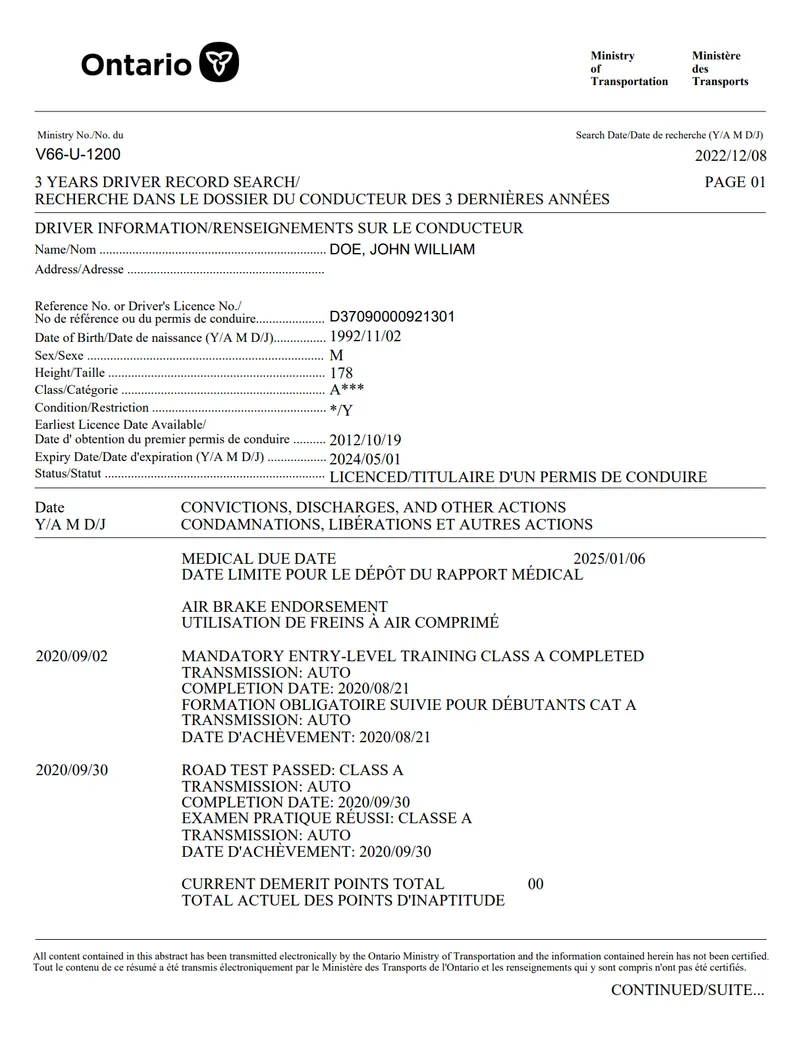
What your 3-year record shows
- Licence status: licensed, unlicensed or suspended
- Licence class, conditions and endorsements, such as air brakes
- The earliest licence date available
- Your current demerit point total
- Highway Traffic Act and Criminal Code convictions from the past 3 years
- Suspensions and reinstatements from the past 3 years, and active fine suspensions
What it does not show
- Your home address
- Collisions, which are not among its listed contents
- Expired medical suspensions
- Parking tickets, which are not reported to your driving record
- Non-driving criminal history, which is what the police check is for
The earliest licence date available also lets you check your own years of experience against a three-year rule like Toronto’s before you apply.
The police check is a separate document; drivers abstract vs police record check explains the difference. Worried about a past collision? Does a drivers abstract show accidents covers what appears and what does not. Then get your driving record online and read it the way a licensing clerk will.
How do you get your driver abstract before you apply?
Order it online here: one short form with your licence number, $39.99 paid once, and the PDF arrives in your inbox instantly after payment. Occasional delays can occur.
You need your Ontario licence number, printed on the front of your card: 15 characters, one letter followed by 14 digits. Type it carefully. If you cannot find it, see where to find your Ontario licence number.
There is no account and no subscription. The PDF is ready to upload to a licensing portal, attach to a job application or print for a counter visit, and it shows you exactly where you stand against a 9-point or 6-point line before anyone else reads it.
Driving a bus or coach for a CVOR carrier? The Ontario CVOR Driver Abstract is $39.99, paid once, and also arrives by email. For the wider picture on job checks, see drivers abstracts for employment, or order your driving abstract online now.
Frequently asked questions
What happens if a school bus driver goes over 8 demerit points?
The Class B or E licence is automatically downgraded to the next class you qualify for, usually C or F, until your points fall below eight. Getting the licence in the first place has a lower bar: no more than 6 points when you apply.
Can I drive a taxi in Toronto with a G2 licence?
No. Toronto asks for a valid Ontario Class G licence or higher, plus at least three years of driving experience. Mississauga also sets Class G as the minimum for taxi and limousine drivers.
Will one speeding ticket stop me getting a Toronto taxi licence?
Usually not on its own. A speeding conviction under 50 km/h over adds at most 4 points, and Toronto refuses at 9 or more. The exceptions are speeding 50 km/h or more over and stunt driving (possible at 40 km/h or more over where the limit is under 80), both on the City's list of convictions that count against you for five years.
What does Toronto check when I renew my taxi or limo licence?
The same screening criteria as a first application: the City refuses a renewal at 9 or more demerit points on your driving record abstract, or after a listed conviction in the past five years. The renewal notice lists every document the City wants, so know your point total before you renew.
Is a drivers abstract the same as the police check for these licences?
No. The abstract is your driving record and the police check covers criminal history. Toronto asks for both, and school bus licence applicants send a Criminal Record and Judicial Matters Check to the Ministry of Transportation as well as passing a driver record search.
Do I need a CVOR Driver Abstract to drive a school bus?
Not for the licence itself. Bus operators hold a CVOR and may ask for the CVOR Driver Abstract, which covers up to five years of your commercial driving in Ontario, alongside or instead of the 3-year record. Ask which one they want; both are available here.
Does my abstract show accidents for a limo or bus job?
Collisions are not listed among the contents of the 3-year record. The CVOR Driver Abstract is different: it includes collisions linked to a safety-related conviction, along with convictions and inspections from your commercial driving in Ontario.
Can I use the same abstract for Toronto and Mississauga?
Yes, while it is recent enough for both. It is the same Ontario driver record, but Toronto wants it less than 30 days old and Mississauga wants one completed in the last 30 days.
Sources: Toronto requirements and screening criteria: City of Toronto, Taxicab or Limousine Driver (Vehicle-for-Hire Driver) and Drivers for Private Transportation Companies licensing pages, under Toronto Municipal Code Chapter 546. Mississauga: City of Mississauga taxicab and limousine licence application pages. School bus and bus licences: Ontario Regulation 340/94 (Drivers’ Licences), sections 12, 13 and 16, the Official MTO Bus Handbook and the Ministry of Transportation’s bus driver’s licence page. Commercial medical reports: Ministry of Transportation medical standards for commercial drivers. CVOR and operator abstract checks: Ministry of Transportation CVOR pages and the Commercial Vehicle Operators’ Safety Manual. Demerit points: Ontario Regulation 339/94. Record contents: the Ministry of Transportation’s description of the 3-year driver record. City rules change; confirm current requirements with the licensing office where you will drive.