

What does MVR mean in Ontario?
MVR stands for motor vehicle record: the history of a driver’s licence, convictions and suspensions kept by the licensing authority. In Ontario that authority is the Ministry of Transportation (MTO), and the document is called a driver record, which Ontario notes is also called an abstract.
MVR is the usual term in the United States, which is why it turns up on background-screening forms and in paperwork from employers based there.
- 3 yearsof convictions, suspensions and reinstatements on the standard record
- 2 yearshow long demerit points count, from the offence date
- 5 yearsthe furthest back the CVOR Driver Abstract goes, for commercial drivers
- $39.99paid once for your 3-year record, delivered instantly by email
Is an MVR the same as a drivers abstract?
Yes. In Ontario, an MVR and a drivers abstract are one document, the uncertified 3-year driver record, and so is almost every other name a request might use.
A few terms in a request change what you should send: certified, CVOR, licence history, or a longer period such as 5-year. A request for a letter is a different thing again.
| If the request says | What it means in Ontario | What to send |
|---|---|---|
| MVR, MVR report, MVR abstract, motor vehicle record, drivers abstract, driver's abstract, driver record, driving record, driving abstract or MTO abstract | All names for the same document, your Ontario driver record | Uncertified 3-year driver record |
| Driver history or driving history | Usually the driver record. Check it does not say "licence history" or "letter" | Uncertified 3-year driver record, unless told otherwise |
| Driver's licence history | A different record: licence replacements, renewals, class changes, driver education and addresses, with no convictions or points | Not an MVR in the usual sense. Ask before sending anything |
| Certified abstract or certified record | A copy carrying a Ministry of Transportation seal | Rarely needed outside legal matters. Ask whether the uncertified 3-year record will do |
| 5-year, extended or complete driver record | A longer-term record for when someone needs more detail or a longer period. The 5-year driver record is not the same as the five-year CVOR Driver Abstract | Most requests do not need one. Ask whether the 3-year record will do |
| Driver confirmation letter or driver history letter | A letter, not a driver record, for details a record does not show, such as when you apply to drive in another province or country | Follow the exact wording of the request |
| CVOR abstract or CVOR driver record | For commercial drivers, the five-year CVOR Driver Abstract | CVOR Driver Abstract |
A driver’s licence history sounds like an MVR, but it carries no convictions and no demerit points, so it cannot show anyone how you drive. The difference is set out in driver abstract vs licence history, and every Ontario record is compared side by side in Ontario driver record types.
What is on an Ontario MVR?
An Ontario MVR shows who you are, what you are licensed to drive, whether your licence is valid, your demerit point total, and any convictions, suspensions and reinstatements from the past three years. It does not show your home address.
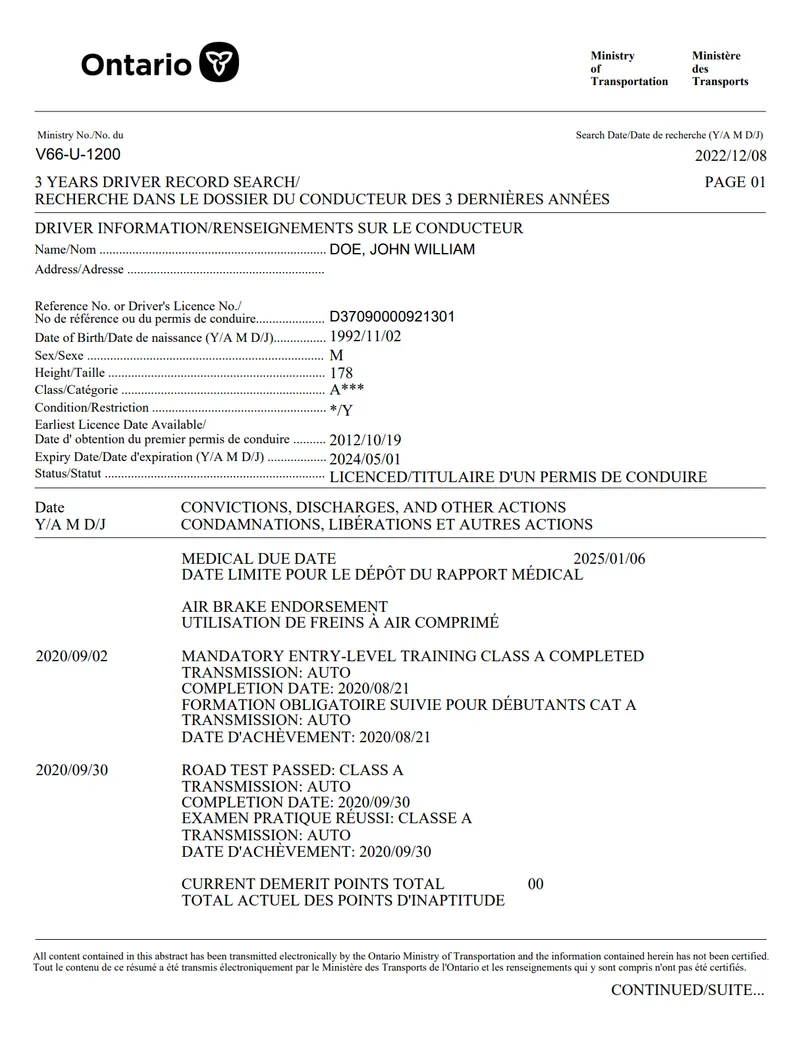
On the 3-year record
- Name, licence number, date of birth, sex and height
- Licence class, expiry date and status, for example licensed, unlicensed or suspended
- Earliest licence date available
- Conditions and endorsements, such as corrective lenses or air brakes
- Your demerit point total
- Highway Traffic Act and Criminal Code convictions from the past 3 years
- Suspensions, reinstatements and active fine suspensions from the past 3 years
Not on it
- Your home address
- Beginner driver education course completion
- Expired medical suspensions
- Collisions (a conviction that came out of one does show)
- Parking tickets, which are not reported to the driving record
- Your insurance claims history
Claims history is a separate file. Insurers see it through AutoPlus, a database built from information insurers submit, and it is not part of the record the MTO keeps. Your MVR answers a narrower question: what have the courts and the ministry recorded about your driving?
Collisions are not listed among the 3-year record’s contents, but a conviction that came out of one, such as careless driving, shows up like any other. The complete driver record lists collisions, and the CVOR Driver Abstract lists commercial collisions linked to a safety-related conviction. More on that in does a driver abstract show accidents.
Convictions reach the record because the court that enters them reports them to the Registrar of Motor Vehicles. Paying a ticket counts as a conviction, so a ticket you paid and forgot about is exactly the kind of entry that shows up. For a line-by-line tour of the document, see what is on an Ontario driver abstract.
What is a clean MVR?
A clean MVR has no convictions, no suspensions and no demerit points in the period the reviewer checks, on a valid licence of the right class. In Ontario that period is usually the three years the standard record covers.
There is no box on the record marked clean. It is a judgment the reader makes, and insurers and employers do not all draw the line in the same place. What they all read is the same document, which is why your own copy is the only reliable answer.
| What your record shows | Reads as clean? | Why |
|---|---|---|
| Licensed, 0 points, nothing else listed | Yes | Nothing for a reviewer to weigh. |
| 0 points, but a conviction listed | Usually not | Points count for two years from the offence date, while convictions from the past three years stay listed. |
| A novice conviction recorded as 0 points | No | For some novice convictions the points are recorded as zero, but the conviction itself is still on the record. |
| A suspension followed by a reinstatement | No | Both entries stay listed while they fall within the past three years. |
| An active fine suspension | No | An unpaid court-ordered fine has suspended the licence. Paying outstanding fines is the first step to reinstatement. |
| Parking or red light camera tickets | Not affected | Neither carries demerit points. Camera tickets do not go on the driving record, and parking tickets are not reported to it. |
| A medical suspension that has expired | Not shown | Expired medical suspensions are not listed on the 3-year record. |
Waiting out the points from a speeding ticket does not wipe the conviction, so a driver who is sure they are clean can hand over a record that says otherwise. The full definition is in what counts as a clean driving record.
If you are not certain, one read of your 3-year driver record settles it, for $39.99, paid once.
When does an MVR request mean the CVOR Driver Abstract?
When the job is driving a commercial vehicle for a carrier in Ontario, “MVR” can mean the CVOR Driver Abstract, and a carrier may ask for it, the 3-year record, or both. Commercial here means vehicles such as trucks over 4,500 kg, buses with seating for 10 or more passengers, and tow trucks.
The CVOR Driver Abstract covers up to five years of your commercial driving in Ontario: convictions for safety-related offences, inspections, and collisions linked to a safety-related conviction. It also shows your licence status, class, conditions and medical due date, but no demerit point total. The medical date matters: if a commercial licence holder’s medical report is not received by the due date, the licence is downgraded to Class G.
3-year driver record
- Any Ontario licence, any class
- Licence status, class, conditions and point total
- Convictions, suspensions and reinstatements from the past 3 years
- Used for insurance, most jobs, rideshare and rentals
CVOR Driver Abstract
- Your time operating commercial vehicles in Ontario
- Safety-related convictions, inspections, and collisions linked to a safety-related conviction
- Up to five years of history
- Licence status, class, conditions and medical due date
MTO’s safety manual for operators tells carriers to obtain a driving abstract when they hire a driver and at least every year after that, and driver abstracts are reviewed in a facility audit. So a carrier may ask again every year you drive for it.
One more trap: CVOR Level 1 and Level 2 abstracts describe a carrier, not a driver. If you are the driver, the CVOR record anyone means is the Driver Abstract. See CVOR Driver Abstract vs driver abstract for the full comparison.
Who asks for an MVR, and why?
Anyone who carries risk when you drive. Insurers, employers, carriers, rideshare and delivery platforms, rental companies and licensing offices elsewhere all ask for some version of your MVR.
| Who asks | What they usually call it | What they are checking |
|---|---|---|
| Insurance company or broker | Drivers abstract, driving record, MVR | The standard Ontario auto insurance application asks for every driving conviction in the last 3 years, the same window the 3-year record covers. |
| Employer hiring for a driving role | Driving record, MVR, abstract | That your licence is valid and the right class, and what your recent convictions look like. |
| Background-screening company | MVR or MVR report | The driving part of a pre-employment check, carried out for an employer. |
| Commercial carrier or fleet | CVOR abstract, MVR | Your driving record and commercial driving events, at hiring and at least once a year after. |
| Rideshare or delivery platform | Driving record, abstract | Your record, usually before you can start driving. |
| Car rental company | Driving record, MVR | A valid licence and a low-risk record. |
| Licensing office in another province or country | Driving record, driver abstract | Your history when you apply for a licence there. Some ask for originals or a specific letter, so check the wording. |
With your record in hand, you can fill in an insurance application from the page instead of from memory. The common cases each have their own guide: getting a drivers abstract for insurance, using a drivers abstract for employment and renting a car with your driving record.
Should you check your own MVR first?
Yes. Whoever asked for it will read it either way, and your own copy lets you:
- Know what will come up before an interview or an insurance quote, and prepare an explanation
- Confirm points from an old ticket have passed their two-year mark
- Check your status reads licensed, not suspended, before you drive for work
- Spot a conviction you did not know about, such as a ticket that never reached you
- Make sure your name and licence number match your licence card
It is the driver’s responsibility to make sure the licence is valid before driving. An unpaid court fine can lead to a suspension, and it appears on the record as an active fine suspension.
Better to find a conviction like that on your own copy than in a recruiter’s email. Check your Ontario drivers abstract while there is still time to act on what it says.
How do you get your Ontario MVR online?
Order the uncertified 3-year driver record online with one short form: enter your name, Ontario licence number and email, pay $39.99 once, and the PDF arrives in your inbox instantly after payment.
Find your licence number
It is on the front of your licence card: 15 characters, one letter followed by 14 digits, printed like A1234-56789-01234. It is not the 7-digit trillium number on the back.
Fill in one short form
Your name as it appears on your licence, your licence number and the email address the PDF should go to. There is no account to create.
Pay through secure checkout
$39.99 for the 3-year record, paid once. No subscription and nothing to renew.
Open the PDF and send it on
Your record arrives by email instantly after payment (occasional delays can occur). Check the search date at the top and your details, then forward the same PDF to whoever asked for your MVR.
Time the order to the request. Many insurers and employers ask for a record issued within the last 30 days (more in how long a drivers abstract is valid), so one copy ordered close to the deadline can go to an insurer and an employer alike. Get your driving record online and give the person asking the exact document they meant.
Frequently asked questions
What is an MVR report?
An MVR report is a copy of a driver's motor vehicle record, usually requested during hiring or an insurance application. For an Ontario licence, the record behind it is the Ontario driver record, so ordering your own 3-year record shows you the same recent history a reviewer will see.
Can I send a drivers abstract when a form asks for an MVR abstract?
Yes. "MVR abstract" combines two names for one document. In Ontario it means the uncertified 3-year driver record, unless the request asks for a certified copy, a CVOR abstract, a licence history or a longer period.
Does a licence status check count as an MVR?
No. Ontario's online licence status check only tells you whether a licence is valid right now, along with any licensing conditions. It shows no convictions, no demerit points and no suspension history, which is the part of the 3-year record an MVR request is really after.
How far back does an Ontario MVR go?
The standard 3-year record covers convictions, suspensions and reinstatements from the past three years, plus your current demerit point total. Ontario also has longer-term records, but most requests do not need them. For commercial drivers, the CVOR Driver Abstract covers up to five years of commercial driving in Ontario.
Does a clean MVR just mean zero demerit points?
No. Demerit points count for two years from the offence date, while the record lists convictions from the past three years. A record can show zero points and still list a conviction, and a reviewer may not call that clean.
Do parking tickets show up on an Ontario MVR?
Parking tickets are not reported to your driving record. They carry no demerit points, and Ontario treats unpaid parking fines as vehicle fines tied to your licence plate rather than driver fines.
How long does it take to get an Ontario MVR?
Fill in one short form with your name, Ontario licence number and email, pay $39.99 once, and the PDF arrives by email instantly after payment. Occasional delays can occur.
Sources: Record names and contents follow the Ministry of Transportation’s descriptions of the 3-year driver record, the driver’s licence history, its longer-term records and letters, the online licence status check and the CVOR Driver Abstract. Conviction reporting follows the Highway Traffic Act, R.S.O. 1990, c. H.8, s. 210. Demerit points follow Ontario Regulation 339/94 (Demerit Point System). Reopening a conviction entered without a hearing follows the Provincial Offences Act, R.S.O. 1990, c. P.33, s. 11, and a paid ticket counting as a conviction follows s. 8 of the same Act. Commercial vehicle, medical and carrier guidance follows the Highway Traffic Act and MTO’s Commercial Vehicle Operators’ Safety Manual. Insurance questions follow the standard Ontario Application for Automobile Insurance (OAF 1). Camera and parking fine treatment follows Ontario Regulation 355/22 and the Highway Traffic Act.